Newton's second law and its applications
Course · Physics (Grade 11, Lebanon), chapter 6 · Lebanon, Grade 11 · the beginning of the chapter, the rest on Adloun
Having learned in the previous chapter to describe the plane motion of a particle using the position, velocity and acceleration vectors, we now turn to dynamics, the science that relates motion to the causes that produce or modify it: forces. Formulated by Isaac Newton in 1687 in his Principia Mathematica, Newton's second law — or fundamental principle of dynamics — is the cornerstone of all classical mechanics: one and the same vector equation, , governs the glide of a skier on the slopes of the Cedars, the parabolic flight of a soccer ball, the road holding of a car in a banked bend and the revolution of a telecommunications satellite around the Earth.
This sixth chapter states Newton's second law in a Galilean frame of reference and sets out the rigorous method for solving a mechanics problem. We apply it successively to rectilinear motions (inclined plane with or without friction, systems of solids coupled by a string and a pulley), to the ballistic motion of a projectile in the uniform gravitational field , to the dynamics of circular motions in the Frenet frame (conical pendulum, flat or banked bend, vertical loop), and then to the law of universal gravitation and the circular motion of Earth satellites.
Curriculum: LB-1S
Required skills
- Define the linear momentum vector of a particle, state Newton's second law in a Galilean frame of reference () and describe its experimental verification on an air table ( and collinear and in the same direction, ).
- Apply the method for solving a dynamics problem (choice of system, Galilean frame of reference, inventory of external forces, projection onto a Cartesian coordinate system or in the Frenet frame).
- Study the motion of a solid on a horizontal plane or on a plane inclined at an angle (without friction or with solid friction ) and the motion of two bodies coupled by an inextensible string over a pulley.
- Interpret the Newton's tube experiment ( independent of the mass in a vacuum) and establish for a projectile launched in the uniform gravitational field : the time equations and , the Cartesian equation of the trajectory parabola, the maximum height and the horizontal range (oblique launch or horizontal release from an altitude ).
- Project Newton's second law in the Frenet frame ( and ) to study the conical pendulum ( for ), a flat bend or a bend banked at an angle , and a vertical circular track.
- Define the Copernican, heliocentric and geocentric frames of reference, state Newton's law of universal gravitation, express the gravitational field , justify that the orbital plane of every Earth satellite contains the center of the Earth, and establish for a circular satellite of radius the orbital speed , the period and the conditions for the geostationary orbit.
- State and use Kepler's three laws (law of elliptical orbits, law of areas, law of periods ).
6.1 Newton's second law and the method of dynamics
6.1.1 Linear momentum and statement of Newton's second law
In the previous school year, the principle of inertia (Newton's first law) taught us that in a Galilean frame of reference (terrestrial frame for everyday experiments of short duration, geocentric frame for the Earth's satellites, heliocentric frame for the planets), every isolated or pseudo-isolated system () keeps a constant velocity vector (). What happens when the resultant of the external forces is not zero?
The linear momentum vector of a point particle of mass moving with the velocity in a given frame of reference is the vector:
collinear with and in the same direction, whose magnitude is expressed in (or ).
In a Galilean frame of reference, the vector sum (resultant) of the external forces applied to a particle is equal at every instant to the time derivative of its linear momentum vector:
For a particle of constant mass , since , Newton's second law is written:
where is in kilograms (), in and the resultant of the forces in newtons (). For a solid in translation whose points all have the same motion as its center of inertia (or center of mass) , the relation applies to the point : .
6.1.2 Experimental verification on an air table
To verify experimentally the relation between the resultant of the external forces and the acceleration, we carry out the classic experiment with an air puck on a horizontal air table.
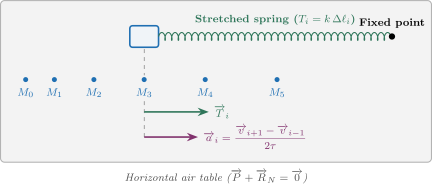
An air puck of mass glides without friction on a horizontal table. Its weight and the normal reaction of the table exactly balance each other (). The puck is pulled horizontally by a spring of stiffness attached to a fixed point: the resultant of the external forces therefore reduces to the horizontal tension of the spring alone, , of magnitude measured at each position from the extension of the spring.
The positions are recorded at constant time intervals . By measuring the speeds and then the accelerations at the successive dates , we obtain the following experimental table:
| Position | ||||
|---|---|---|---|---|
| Tension of the spring () | ||||
| Measured acceleration () | ||||
| Ratio ( or ) |
Experimental conclusions:
- At each instant , the acceleration vector has the same line of action and the same direction as the resultant of the external forces .
- The ratio remains constant during the motion and equal to the mass of the puck: this verifies Newton's second law .
6.1.3 General method for a dynamics problem
Method : The five essential steps of a dynamics study
- Define the mechanical system studied (and specify its mass ).
- Choose the frame of reference of the study, assumed Galilean (terrestrial or geocentric).
- Make a complete inventory of the external forces applied to the system and represent them on a clear diagram (weight , normal reaction of the support perpendicular to the support, friction force opposite to the sliding, tension of the string , gravitational force, etc.).
- Write the vector relation of Newton's second law: .
- Project this vector equation onto suitably chosen axes:
- Cartesian coordinate system (with parallel to the plane of motion for a rectilinear motion, or horizontal and vertical for a projectile):
- moving Frenet frame for any circular motion of radius (or curvilinear motion with radius of curvature ):
6.2 Rectilinear motions: inclined plane and coupled systems
6.2.1 Motion of a solid on an inclined plane
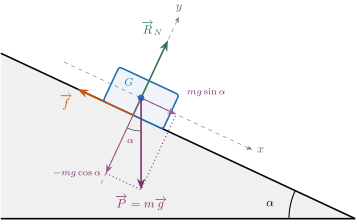
Consider a solid of mass sliding along a line of greatest slope of a plane inclined at an angle to the horizontal. We choose an orthonormal coordinate system with the axis parallel to the slope (oriented in the direction of motion, for example downward) and the axis perpendicular to the inclined plane, oriented upward.
Exercises of the chapter
- A skier sliding down an inclined slope with and without friction solved
- Two solids coupled by a string and a pulley on an inclined plane solved
- Volleyball serve: clearing the net and staying inside the court solved
- Determining the launch angle or the initial speed needed to reach a given target solved
- Swing ride (conical pendulum) and vertical loop solved
- Satellites in low circular orbit and in geostationary orbit solved