Plane motion of a particle
Course · Physics (Grade 11, Lebanon), chapter 5 · Lebanon, Grade 11 · the beginning of the chapter, the rest on Adloun
In the previous school year, the study of motion focused essentially on straight-line trajectories described by a single space coordinate. Yet most of the motions we observe in nature and in technical systems take place in a plane along curved trajectories: a basketball follows a parabolic arc toward the basket, a car takes a hairpin bend on the Dahr el-Baidar road, the blades of a wind turbine turn around their hub, and an artificial satellite follows an orbit around the Earth.
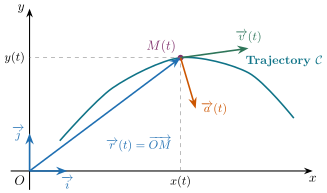
In such a plane curvilinear motion, the velocity is a vector quantity that can change both in magnitude (the moving body speeds up or slows down) and in direction (the trajectory turns). This fifth chapter introduces the vector tools of plane kinematics: the Cartesian coordinate system , which allows us to differentiate the position vector , the velocity vector and the acceleration vector ; the moving Frenet frame , which separates within the acceleration vector the tangential component (change in the magnitude of the velocity) and the normal component (bending of the trajectory, of radius of curvature ); then the complete kinematics of uniform circular motion (UCM) and uniformly varied circular motion (UVCM).
Curriculum: LB-1S
Required skills
- Choose a frame of reference and a space coordinate system or a time reference to describe a plane motion, express the position vector , change the origin of the coordinate system () and establish the Cartesian equation of the trajectory by eliminating the time parameter .
- Define the curvilinear abscissa on an oriented trajectory of origin as well as the displacement vector , and relate the algebraic speed to the velocity vector .
- Calculate by differentiation the velocity vector and the acceleration vector , and construct geometrically and on an air-table recording.
- Use the sign of the dot product to determine whether a motion is accelerated (), decelerated/retarded () or uniform ().
- Define the moving Frenet frame and express the tangential component and the normal component of the acceleration vector, as well as the radius of curvature .
- Define, for a circular motion of radius , the angular abscissa , the curvilinear abscissa , the angular velocity and the angular acceleration , and use the relations , and .
- Establish and use the laws of uniform circular motion (UCM) and uniformly varied circular motion (UVCM), as well as the laws of transmission without slipping of a circular motion by gears () and by belt ().
5.1 Kinematics of a point in a Cartesian coordinate system
5.1.1 Frame of reference, position vector, change of origin and curvilinear abscissa
Kinematics is the branch of mechanics that studies the motion of a moving body (position, velocity, acceleration) without concern for the causes (forces) that produce it. Since motion is relative, its study first requires choosing:
- a frame of reference (a reference solid relative to which the motion is observed, such as the terrestrial frame of reference attached to the laboratory), equipped with an orthonormal space coordinate system — which reduces to when the motion takes place in a fixed plane (the unit vectors and being constant in line of action, direction and magnitude: and );
- a time reference defined by an origin of dates () and a unit of duration (the second, ).
- At each instant , the position of the moving body is located in by its position vector:
whose magnitude represents the distance from the moving body to the origin at the instant (expressed in meters, ).
- The two functions of time and are called the parametric equations (or Cartesian time laws) of the motion in the coordinate system .
- The trajectory is the geometric line formed by the set of successive positions occupied by the moving body . Its Cartesian equation (or ) is a relation between and independent of the time , obtained by eliminating the parameter between and .
If we go from a first coordinate system to a second coordinate system with the same basis but with a fixed origin , Chasles' relation is written for any position of the moving body:
Projecting onto the parallel axes and , the coordinates of in are related to its coordinates in by:
Two billiard balls collide at a point of a horizontal rectangular table of length and width . In the coordinate system with origin the corner , the coordinates of are and . Let us determine the coordinates of in the coordinate system whose origin is the center of the table.
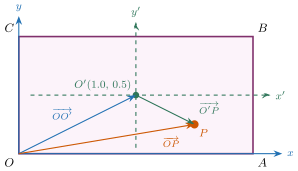
The center of the table has the coordinates in : and , that is . According to Chasles' relation :
The coordinates of a point therefore depend on the choice of the origin of the coordinate system.
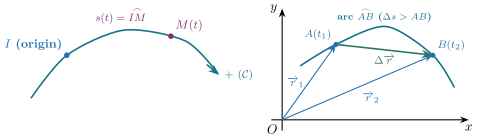
- Curvilinear abscissa and time equation: by choosing on the known trajectory a fixed point as origin and a positive direction of travel, the position of the moving body at the instant is entirely located by the algebraic measure of the arc , called the curvilinear abscissa:
The relation giving the curvilinear abscissa as a function of time is called the time equation of the motion on its trajectory.
- Displacement vector : when the particle goes from the position (at the instant , position vector ) to the position (at the instant , position vector ), the displacement vector between and is the change in the position vector:
The displacement vector is independent of the choice of the origin . Moreover, its magnitude (length of the line segment ) is in general less than or equal to the curvilinear distance actually traveled along the curved trajectory.
If a car travels around a circular track of radius :
- between two diametrically opposite points and (half a lap), the curvilinear distance traveled is , whereas the displacement vector has as magnitude the length of the diameter: ;
- when the car completes a full lap (return to ), the distance traveled is , whereas its displacement vector is the zero vector ().
Exercises of the chapter
- Position, velocity and acceleration vectors and equation of the trajectory solved
- Condition for a rectilinear or curvilinear trajectory under constant acceleration solved
- Frenet decomposition and radius of curvature of a plane trajectory solved
- Curvilinear motion with exponential or polynomial speed solved
- Uniform circular motion: from the satellite to the clock solved
- Complete cycle of a centrifuge: start-up, steady phase and braking (UVCM + UCM) solved