Acoustic energy and sound intensity
Course · Physics (Grade 11, Lebanon), chapter 4 · Lebanon, Grade 11 · the beginning of the chapter, the rest on Adloun
Between the barely perceptible rustling of the leaves of a cedar in the breeze and the roar of an airplane taking off at Beirut airport, the acoustic power received by each square centimeter of our eardrum varies in a gigantic ratio of one to ten thousand billion (). Yet our ear manages to detect the first without being immediately destroyed by the second: the physiological sensation of loudness does not grow in proportion to the energy received, but according to its logarithm.
This fourth chapter, which closes the acoustics part of the curriculum, quantifies the transport of energy by sound waves and the physiological qualities of musical sounds. We define the acoustic power of a source and the sound intensity (with its law for a spherical wave), then the sound intensity level in decibels (). We then establish the rules for combining the sound levels of several sources and for attenuation with distance, before studying the three physiological qualities of a sound: pitch (fundamental frequency), timbre (spectrum of harmonics) and loudness (perceived loudness and the Fletcher-Munson diagram).
Curriculum: LB-1S LB-1H
Required skills
- Define the acoustic power () of a source and the sound intensity () through a surface , and use the proportionality of the power of a sinusoidal wave to the square of its amplitude (, ).
- Apply the conservation of acoustic power for an isotropic spherical wave without absorption (, ) and use the inverse-square law of distance .
- Know the reference sound intensity at the threshold of hearing at (), define and calculate the sound intensity level in decibels () and invert this relation: .
- Combine the effects of several sound sources by adding the sound intensities (); prove the rules of (doubling of ) and (doubling of the distance ), and know the maximum daily exposure times as a function of the sound level.
- Relate the three physiological qualities of a sound (pitch, timbre, loudness) to the corresponding physical quantities (fundamental frequency , spectrum of harmonics , vibration amplitude).
- Explain physically the Doppler effect, establish and apply the relations giving the perceived frequency for a moving source () or a moving observer (), and cite its applications (traffic radar, Doppler ultrasound, astrophysics).
4.1 Acoustic power and sound intensity
4.1.1 Acoustic energy, power and intensity
Every vibrating sound source gives mechanical energy to the material medium around it. If a source radiates an acoustic energy during the time , its average acoustic power is given by:
As one moves away from the source, this acoustic power spreads over a wavefront of ever larger area. What determines the physical effect on a receiver of given area (such as the eardrum of area or the capsule of a microphone) is the power received per unit area.
The sound intensity (or acoustic intensity) at a point of the medium is the acoustic power transferred by the sound wave per unit area of a surface perpendicular to the direction of propagation:
where is expressed in watts per square meter (), in watts () and in square meters (). The acoustic energy received during a time by a receiver of area facing the wave is then:
For a sinusoidal sound wave of frequency and vibration amplitude , the acoustic power (and hence the sound intensity at a given point) is proportional to the square of the amplitude :
where the coefficients and depend on the nature of the propagation medium and on the frequency . Thus, multiplying the amplitude of the vibration by a factor multiplies the sound intensity by and increases the sound level by .
4.1.2 Spherical wave emitted by an isotropic point source
Consider a point sound source of acoustic power , placed in a homogeneous, unbounded, non-absorbing medium, which emits isotropically (identically in all directions of space). The wave surfaces centered on are spheres of radius and area:
If the source is placed on a perfectly reflecting ground and radiates uniformly into the upper half-space, the wave is hemispherical and crosses a hemisphere of area .
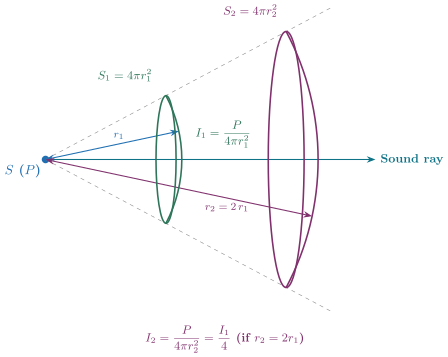
For an isotropic point source of acoustic power radiating spherical waves in a medium without absorption, the sound intensity at the distance from the source is:
Between two points located at the distances and from the same source, the conservation of power leads to:
In particular, when the distance to the source is multiplied by (), the sound intensity is divided by ; when the distance is multiplied by , the intensity is divided by .
4.2 Sensitivity of the ear and sound intensity level in decibels
4.2.1 Thresholds of hearing and of pain — Logarithmic scale
At the reference frequency (where the human ear is very sensitive):
- the smallest sound intensity capable of producing an auditory sensation in a young subject with normal hearing is called the threshold of hearing (or reference intensity):
- the intensity from which the sound causes physical pain in the ear and a risk of immediate damage is the threshold of pain:
Exercises of the chapter
- From the power of a warning siren to the perceived sound level solved
- Reasoning with the logarithmic scale: from to and attenuation rules solved
- Adding sound intensities (and never decibels!) solved
- Sound insulation of a music rehearsal room solved
- Pitch, timbre and spectrum of harmonics of two instruments solved
- Acoustic Doppler effect: ambulance, racing car and bat solved