Magnetic field created by an electric current
Course · Physics (Grade 11, Lebanon), chapter 13 · Lebanon, Grade 11 · the beginning of the chapter, the rest on Adloun
For centuries, electricity and magnetism were studied as two completely independent fields of physics: electric charges acted on electric charges, while magnets acted only on magnets and on soft iron. Everything changed in the spring of 1820 when the Danish physicist Hans Christian Œrsted observed, during a lecture demonstration in Copenhagen, that a metal wire carrying an electric current deflects at a distance a magnetic needle placed near it. A few weeks later, in Paris, André-Marie Ampère, Jean-Baptiste Biot and Félix Savart established the quantitative laws of this phenomenon and showed that a winding of wire carrying a current behaves exactly like a magnet. This discovery founded electromagnetism and paved the way for electromagnets, electric motors, relays, loudspeakers and the coils of magnetic resonance imaging (MRI). This chapter studies the layout and the characteristics of the magnetic field vector created by the four fundamental geometries of conductors carrying a direct current: the infinite straight conductor, the circular loop, the flat coil and the long solenoid.
Curriculum: LB-1S
Required skills
- Describe Œrsted's historical experiment and deduce from it that an electric current creates a magnetic field whose sense depends on the direction of the current and whose magnitude is proportional to the current .
- Know the value and the SI unit of the permeability of free space: .
- Draw the magnetic field pattern and determine the direction, the sense (right-hand rule or Ampère's swimmer rule) and the magnitude of the magnetic field created by an infinite straight conductor at a distance .
- Determine the characteristics of the magnetic field vector at the center of a circular loop or of a flat coil of turns of radius (), identify its north and south faces, and know the principle of Helmholtz coils (, uniform field ).
- Define a long solenoid (), draw its magnetic field pattern, identify its north and south faces and calculate the magnitude of the uniform magnetic field in its central region: .
- Name the three laboratory devices that produce a uniform magnetic field (air gap of a U-shaped magnet, inside of a long solenoid, central region of two Helmholtz coils).
- Interpret magnet--coil and coil--coil interactions through the North/South polarity of the faces, explain the role of the soft-iron core in an electromagnet (an electrically controlled temporary magnet) and describe its applications (trembler bell, lifting electromagnet).
- Apply the principle of superposition to the field created by a conductor and to the horizontal Earth's magnetic field to determine the deflection of a magnetic needle (tangent-galvanometer method).
13.1 Œrsted's historical experiment and general properties
13.1.1 Experimental evidence (1820)
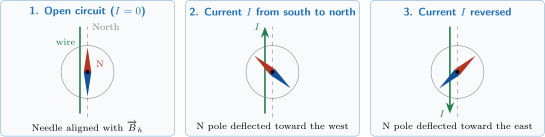
Let us place a long straight horizontal conducting wire just above a magnetic needle free to turn about a vertical axis (compass), parallel to the initial south--north direction indicated by the needle at rest in the Earth's magnetic field.
- Open circuit (): the magnetic needle remains oriented along the Earth's magnetic meridian, its north pole pointing toward magnetic north (vector ).
- Closed circuit ( from to ): as soon as the current flows in the wire, the magnetic needle deflects abruptly through an angle and comes to rest in a new equilibrium direction. If the current is very large, the needle sets itself almost perpendicular to the wire.
- Reversing the direction of the current ( from to ): by swapping the terminals of the generator without changing the value of , the magnetic needle deflects the opposite way through the same angle .
- Varying the current : when the current is increased with a rheostat, the angle of deflection increases; when the wire is moved away from the compass, the angle decreases.
13.1.2 Qualitative laws and permeability of free space
Œrsted's experiment proves that any moving electric charge (hence any electric current) modifies the magnetic properties of the space around it: a conductor carrying a current creates at every point in its vicinity a magnetic field characterized by a vector .
In vacuum (or in air), in the absence of any ferromagnetic material:
- The direction of the magnetic field vector at a point depends only on the geometry of the electric circuit and on the position of the point .
- The sense of the vector depends on the direction of the electric current: if the direction of the current is reversed, the vector reverses its sense while keeping the same direction and the same magnitude.
- The magnitude is directly proportional to the current flowing through the conductor:
where the proportionality coefficient depends on the geometric shape of the conductor, on the position of the point and on a fundamental constant called the permeability of free space, denoted by :
In magnetostatics, figures are very often drawn as cross-sections in the plane of the page. To represent a vector or a current perpendicular to the plane of the drawing:
- the symbol (a dot inside a circle, like the tip of an arrow coming toward the observer) denotes a current or a vector coming out of the plane of the page (toward the front);
- the symbol (a cross inside a circle, like the tail feathers of an arrow moving away) denotes a current or a vector going into the plane of the page (toward the back).
13.2 Magnetic field created by an infinite straight conductor
13.2.1 Magnetic field pattern and orientation of the field lines
Consider a very long straight conducting wire (modeled as infinite as soon as its length is much greater than the observation distance), passing perpendicularly through a horizontal board sprinkled with iron filings. When a strong direct current (a few amperes to a few tens of amperes) is passed and the board is tapped lightly, the filing grains become magnetized and line up along concentric circles centered on the conducting wire and lying in the plane perpendicular to the wire.
If small compasses are placed on one of these circles, their north poles all indicate the same way of going around the circle; if the direction of the current is reversed, all the compasses turn completely around.
Method : Rules giving the orientation of the field created by a straight wire
Three equivalent rules make it possible to determine the direction of the field lines and of the vector at a point :
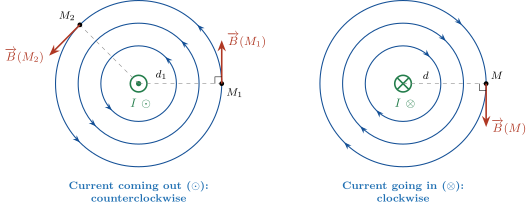
- Right-hand rule (or grip rule): imagine gripping the conducting wire with the right hand so that the outstretched thumb points in the direction of the current . The four other fingers curled around the wire then indicate the direction of the magnetic field lines (and therefore the direction of at each point ).
- Ampère's swimmer rule: an observer lying along the wire, with the current flowing from feet to head, and looking at the point , sees the vector pointing toward his left arm.
- Maxwell's corkscrew rule: the direction of the field lines is the direction in which a corkscrew (or a standard-thread screw) must be turned for it to advance in the direction of the current .
In particular, in the plane perpendicular to the wire:
- if the current is coming out (), the field lines turn counterclockwise (the positive direction);
- if the current is going in (), the field lines turn clockwise.
13.2.2 Characteristics of the magnetic field vector
An infinite straight conductor carrying a direct current creates at every point located at the distance (with ) from its axis a magnetic field vector with the following four characteristics:
- Point of application: the point considered.
- Direction: perpendicular to the plane defined by the conducting wire and the point ; in other words, is tangent to the circle of radius centered on the wire and passing through (hence perpendicular to the radius , where is the orthogonal projection of onto the wire).
- Sense: given by the right-hand rule (thumb along , curled fingers along ).
- Magnitude (or norm): in vacuum or in air,
where is expressed in amperes (), in meters () and in teslas ().
The formula shows that the magnetic field created by a straight wire is not uniform: its direction turns around the wire and its magnitude is inversely proportional to the distance from the wire. If the distance is doubled, the magnitude of the field is divided by .
A long straight cable carries a direct current . At the distance from the axis of the cable, the magnitude of the magnetic field created is:
This value is about five times greater than the horizontal component of the Earth's magnetic field (), which explains the strong deflection of the compass observed by Œrsted. On the other hand, at from the same cable, the field drops to , a value twenty times smaller than .
Exercises of the chapter
- Quantitative Œrsted experiment: deflection of a compass under a straight wire solved
- Superposition of the fields created by two parallel wires at any point of the plane solved
- Circular loop, flat coil and compensation of the field of a tangent straight wire solved
- Solenoid with several layers of close-wound turns and use of the straight line solved
- The tangent-galvanometer method: graphical determination of solved
- Solenoid with its axis oblique to a uniform magnetic field solved