Laplace and Lorentz electromagnetic forces
Course · Physics (Grade 11, Lebanon), chapter 14 · Lebanon, Grade 11 · the beginning of the chapter, the rest on Adloun
Since a conductor carrying an electric current exerts a mechanical action on a magnet (Œrsted's experiment), the principle of reciprocal actions suggests that, conversely, a magnet — and more generally any magnetic field — must exert a mechanical force on a conductor carrying an electric current. Demonstrated as early as the fall of 1820 by André-Marie Ampère and formulated mathematically by Pierre-Simon de Laplace, this Laplace electromagnetic force converts electrical energy into mechanical energy in all electric motors, electrodynamic loudspeakers, moving-coil galvanometers and field-measuring instruments such as the Cotton balance. At the end of the nineteenth century, Hendrik Antoon Lorentz revealed its microscopic origin: since an electric current is nothing but a collective motion of charge carriers, the macroscopic Laplace force is the resultant of the Lorentz magnetic forces exerted individually on each charged particle moving in the magnetic field. This chapter studies these two fundamental laws and their major applications, from Laplace's rails to the uniform circular motion of a beam of charged particles in a cyclotron or a mass spectrometer.
Curriculum: LB-1S
Required skills
- Determine the direction, the sense (right-hand rule or Ampère's swimmer rule) and the magnitude of the cross product of two vectors.
- Describe the experimental evidence for the Laplace force (Laplace's pendulum and Laplace's rails) and state Laplace's law , giving its four characteristics.
- Analyze the behavior of a rod on Laplace's rails according to the orientation of (including the case where is parallel to the rails and lifts the rod intermittently if ), the equilibrium on inclined rails, the rod hanging from springs or wires, and the Cotton balance.
- Explain the structure and operation of the electrodynamic loudspeaker (role of the radial magnetic field in the annular air gap) and of the direct-current electric motor (roles of the stator, of the rotor and of the commutator--brushes system, which reverses the current every half-turn to keep the driving couple in the same direction).
- Express the Lorentz magnetic force acting on a particle of charge moving with a velocity in a magnetic field , taking into account the sign of the charge .
- Prove that the power and the work of the Lorentz magnetic force are always zero, and deduce that the magnitude of the velocity and the kinetic energy of a particle in a purely magnetic field remain constant.
- Prove that the motion of a charged particle injected with a velocity perpendicular to a uniform magnetic field is plane, circular and uniform, and establish the expressions of the radius and of the cyclotron period .
14.1 Mathematical tool: the cross product of two vectors
In electromagnetism, the force exerted by a magnetic field is perpendicular both to the direction of motion of the charges (or of the current) and to the direction of the magnetic field . The natural mathematical tool that expresses this double perpendicularity in three-dimensional space is the cross product (or vector product).
Let and be two vectors of space making a geometric angle with each other. The cross product of by , written (read “ cross ”), is the unique vector defined by:
- If and are collinear ( or , or if one of the two vectors is zero), then .
- If and are not collinear:
- Direction: is perpendicular to the plane defined by and (so and ).
- Sense: the triple forms a right-handed set, given by the right-hand rule.
- Magnitude:
Method : Practical right-hand rules to orient
- Three-finger rule of the right hand: placing the thumb of the right hand along the first vector and the index finger along the second vector , the middle finger bent perpendicular to the palm indicates the direction of .
- Right-hand palm rule: stretch the four fingers of the right hand in the direction of the first vector and turn the palm (the inner face of the hand) so that the second vector comes out of the palm (or so that curling the fingers folds onto ): the thumb held out at a right angle then indicates the direction of .
For all vectors , and every real number :
- Antisymmetry (anticommutativity): swapping the order of the two vectors reverses the cross product:
- Associativity with respect to multiplication by a scalar:
- Maximum magnitude: when (, so ), the magnitude is maximum and is simply .
14.2 Laplace electromagnetic force on a conductor carrying a current
14.2.1 Experiment: deflection of a movable vertical conductor (Laplace's pendulum)
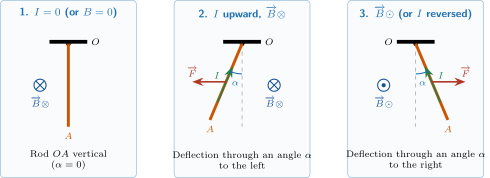
To bring out the factors on which the action of a magnetic field on an electric current depends, let us set up the following circuit: a rigid straight copper rod , hanging vertically and free to pivot about its upper end , is connected by its lower end to a long, very flexible conducting wire (which does not hinder its motion) in series with a DC voltage generator, a switch , a rheostat and an ammeter. The central part of the rod passes between the poles of a U-shaped magnet that creates a horizontal magnetic field .
- Switch open with the magnet present (, ): the rod does not move and remains vertical ().
- Switch closed with the magnet absent (, ): the current flows from to , but the rod still remains vertical ().
- Current and field present simultaneously ( from to , going in ): as soon as the magnet is put back in place, the rod deflects to the left through an angle and stays in equilibrium there.
- Reversing (magnet turned over, coming out ) or reversing the direction of ( from to ): the rod deflects through the same angle to the right.
- Influence of , of and of the angle : the angle of deflection increases when the current is increased (with the rheostat) or when a stronger magnet is used (larger ); it also depends on the inclination of with respect to the rod and becomes zero if is parallel to .
14.2.2 Laplace's rails experiment
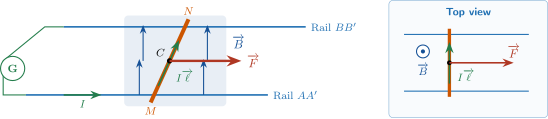
A cylindrical copper rod (or ), movable with no appreciable friction, is laid perpendicularly across two horizontal parallel conducting rails and connected to the terminals of a direct-current generator through a switch and a rheostat. The central part of the rod , of length , is placed between the arms of a U-shaped magnet that creates a uniform magnetic field .
- As long as the switch is open () or the magnet is removed (), the rod remains still.
- As soon as the switch is closed in the presence of a vertical field ( and ), the rod starts moving along the rails, perpendicular to itself and to the field : it is subjected to an electromagnetic force called the Laplace force .
- If the direction of the current is reversed (by swapping the terminals of the generator) or if the field is reversed (by turning the U-shaped magnet over), the rod moves off in the opposite direction. If and are reversed simultaneously, the direction of the force remains unchanged.
- The larger the current , the magnitude of the magnetic field or the length immersed in the field, the stronger the force.
14.2.3 Statement of Laplace's law
A straight portion of a conductor of length , carrying a direct current and entirely immersed in a uniform magnetic field , is subjected to an electromagnetic force , called the Laplace force, given by the vector expression:
where is the length vector of the portion of conductor immersed in the field, of magnitude and oriented in the direction of the current .
The four characteristics of the Laplace force are:
- Point of application: the midpoint of the straight portion immersed in the uniform field .
- Direction: perpendicular to the plane formed by the conductor and the magnetic field vector ( and ).
- Sense: given by one of the three equivalent rules:
- Three-finger rule of the right hand: thumb along , index finger along , the middle finger indicates .
- Right-hand palm rule: the four fingers stretched along , the field coming out of the palm, the thumb held out indicates .
- Ampère's swimmer rule: an observer placed along the conductor so that the current enters through his feet and leaves through his head, and looking in the direction of , points with his outstretched left arm in the direction of the force .
- Magnitude (or norm):
where is the angle between the conductor and the magnetic field vector, with in amperes (), in meters (), in teslas () and in newtons ().
Exercises of the chapter
- Equilibrium and setting in motion of a rod on inclined Laplace's rails solved
- Cotton balance with unequal arms and calibration of an electromagnet solved
- Electrodynamic interaction between two parallel straight wires (historical definition of the ampere) solved
- Comparing the paths of an electron, a proton and an alpha particle solved
- Crossing a magnetic strip of width and deflection on a screen solved
- Principle of the cyclotron: independence of the period and maximum energy solved