Alternating current, transformer and household safety
Course · Physics (Grade 11, Lebanon), chapter 15 · Lebanon, Grade 11 · the beginning of the chapter, the rest on Adloun
Every day, all it takes is pressing a switch or plugging an appliance into a wall socket to have electrical energy instantly available: lighting, heating, refrigeration, charging computers and phones. Behind this familiar gesture lies a remarkable technological chain linking the power stations that produce electricity (thermal, hydroelectric or solar) to homes, by way of extra-high-voltage transmission lines and transformer substations. Why is the electricity distributed by the national grid sinusoidal alternating ( – in Lebanon) rather than direct like that of a cell or a battery? How does a transformer raise the voltage to several tens or hundreds of thousands of volts to transmit energy over long distances without wasting it as heat in the cables, before lowering it to at the entrance to neighborhoods? Finally, how is a household electrical installation wired, and how do the fuse, the circuit breaker, the ground connection and the residual current device protect homes against fires and their occupants against electrocution? This chapter, intended for the Humanities section, answers all these practical, everyday questions.
Curriculum: LB-1H
Required skills
- Distinguish a DC voltage from a sinusoidal alternating voltage; explain the principle of its production by an alternator (magnet rotating in front of a coil).
- Define and use the period , the frequency , the maximum value and the effective value of the mains voltage in Lebanon (, ).
- Calculate the electric power and the energy consumed in joules () and in kilowatt-hours (, with ), and interpret an electricity bill.
- Describe how a transformer is built, use the transformation ratio as well as the relation between the currents (ideal transformer) and the efficiency .
- Explain why electrical energy is transmitted at extra-high voltage by expressing the Joule-effect losses in a line of resistance : .
- Identify the three terminals of a mains socket (phase, neutral, ground), justify connecting household appliances in parallel, explain the dangers of electric current for human beings and the precise role of each safety device (fuse, circuit breaker, ground connection and residual current device).
15.1 Direct current and sinusoidal alternating current
15.1.1 Producing an alternating voltage and its characteristic quantities
Electrochemical cells, rechargeable batteries (car or phone batteries) and photovoltaic panels deliver a DC voltage: the voltage across their terminals keeps a constant sign and a constant value over time, and the electric current always flows in the same direction (from the positive terminal to the negative terminal outside the generator).
By contrast, in power stations (hydroelectric, thermal or wind) as well as in backup generators, electricity is produced by an alternator. Its principle is based on electromagnetic induction, discovered by Michael Faraday in 1831: when a magnet (the rotor) turns steadily in front of a fixed coil of copper wire (the stator), the succession of North and South poles passing the coil produces across its terminals a sinusoidal alternating voltage that changes sign alternately at regular time intervals.
A sinusoidal alternating voltage oscillates regularly between two opposite values and :
- The period , expressed in seconds (), is the shortest time after which the voltage repeats itself identically (duration of a positive half-cycle followed by a negative half-cycle).
- The frequency , expressed in hertz (, with ), is the number of periods (complete cycles) completed in one second:
- The maximum value (or amplitude) , measured with an oscilloscope, is the largest value reached by the voltage during one period.
- The effective (rms) value , measured by a voltmeter used in AC mode ( or ), is related to the maximum value by the relation:
Likewise, the effective current measured by an AC ammeter and the maximum current satisfy .
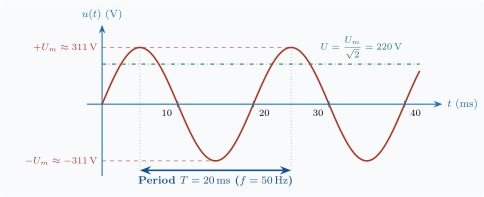
In Lebanon (as in Europe), the electrical voltage distributed by the household network (the mains) is a sinusoidal alternating voltage with the nominal characteristics:
which corresponds to a period and a maximum value equal to:
15.1.2 Electric power and energy consumed: the electricity bill
The rating plate of every household appliance shows its rated supply voltage (usually ) and its rated power , expressed in watts () or in kilowatts ().
Exercises of the chapter
- Reading an oscillogram and comparing a DC voltage with an alternating voltage solved
- Power balance, energy meter and monthly bill of a Lebanese household solved
- Step-up transformer, step-down transformer and efficiency solved
- Electricity transmission: why direct transmission at is physically impossible solved
- Safety diagnosis of a household installation diagram solved
- Physiological effects of current: influence of skin moisture and safety voltage solved