Angular momentum and rotational dynamics
Course · Physics (Grade 12 General Sciences, Lebanon), chapter 3 · Lebanon, Grade 12 General Sciences · the beginning of the chapter, the rest on Adloun
When a figure skater spinning on the ice suddenly pulls her arms in against her chest, her angular velocity increases at once without any external torque having pushed her; when a planet describes its elliptical orbit around the Sun, it speeds up near perihelion and slows down at aphelion; when a massive pulley is set rotating by two masses hanging from a string that does not slip in its groove, the tensions in the two segments of the string are no longer equal as they were for an ideal massless pulley. To explain and calculate all these phenomena, the linear momentum alone is not enough: we must introduce its rotational analog, the angular momentum, and state the angular momentum theorem (or Newton's second law for rotation).
This chapter first defines the vector moment of a force about a point and its algebraic moment about an axis, then the angular momentum of a particle () and that of a rigid body rotating about a fixed axis (). It then proves the angular momentum theorem and applies it to systems combining translation and rotation (Atwood machine with a massive pulley, rolling without slipping on an inclined plane), before studying the law of conservation of angular momentum for systems with a variable moment of inertia and motions under a central force.
Curriculum: LB-SG
Required skills
- Define and calculate the moment vector of a force about a point , , and the algebraic moment about an oriented axis .
- Define the angular momentum vector of a particle about a point , , and express the angular momentum of a rigid body rotating about a fixed axis : .
- Prove the angular momentum theorem for a particle and state it for a rigid body rotating about a fixed axis: .
- Solve a dynamics problem combining translation and rotation (massive pulley driven by one or two solids hanging from an inextensible string that does not slip: and ).
- State and apply the conservation of angular momentum () to deformable systems in free rotation (skater, Joukowski stool) and calculate the corresponding change in rotational kinetic energy .
- Show that the angular momentum of a particle subjected to a central force is conserved and interpret the law of areas.
3.1 Moment of a force about a point and about an axis
3.1.1 Moment vector of a force about a point
Let be a force acting at a point of application and let be a fixed point in space. The moment vector of the force about the point is the cross product of the position vector and the force vector :
By definition of the cross product:
- Direction: is perpendicular to the plane defined by and .
- Sense: given by the right-hand rule (or Maxwell's corkscrew rule) so that the trihedron is right-handed.
- Magnitude: writing and for the perpendicular distance from the point to the line of action of (lever arm):
In particular, the moment is equal to the zero vector if and only if the line of action of the force passes through the point ( and collinear, that is ).
3.1.2 Algebraic moment of a force about a fixed axis
For a rigid body that can rotate about a fixed axis with a unit direction vector (which, by the right-hand rule, fixes the positive sense of rotation about ), the algebraic moment of a force about is the projection onto of the moment vector at any point :
- If the line of action of is parallel to the axis or intersects the axis , its moment about is zero: .
- If the force lies in a plane perpendicular to the axis at the perpendicular distance (lever arm) from , then:
with the sign if tends to rotate the body in the chosen positive sense, and the sign in the opposite sense.
3.2 Angular momentum of a particle and of a rotating rigid body
3.2.1 Angular momentum vector of a particle about a point
In a given frame of reference, the angular momentum vector (written or ) about a fixed point of a particle of mass , velocity and linear momentum is the moment about of its linear momentum vector:
Its magnitude is and is expressed in (or ) in the International System.
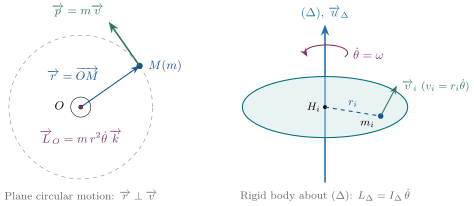
If the particle of mass describes in the plane a circle of center and radius with the algebraic angular velocity (), its angular momentum vector about lies along the axis normal to the plane of the circle and is:
3.2.2 Angular momentum of a rigid body rotating about a fixed axis
Consider a rigid body rotating about a fixed axis with the algebraic angular velocity (). Each particle of mass of the body, located at the perpendicular distance from the axis , describes a circle of center and radius at the speed . Its angular momentum about the axis is . Summing over all the particles of the body (which all have the same angular velocity at the instant ):
- Any system of particles: the algebraic angular momentum (or ) of a system of particles rotating about a fixed axis is equal, at every instant, to the algebraic sum of the angular momenta of its various particles about :
where each term is counted positively if the particle rotates in the chosen positive sense about and negatively if it rotates in the opposite sense.
- Case of a rigid body: since all the particles of the body have, at the same instant, the same algebraic angular velocity (), the algebraic angular momentum (or ) of the body about is equal to the product of its moment of inertia (in ) and its algebraic angular velocity (in ):
For a body that is symmetric about the axis of rotation , the angular momentum vector is collinear with the axis: .
Exercises of the chapter
- Massive pulley connected to a solid on an inclined plane and to a counterweight solved
- Solid sphere rolling without slipping on an inclined plane solved
- Rigid rod released horizontally about a fixed end solved
- Rings sliding without friction on a rotating horizontal rod solved
- Projectile passing through the end of a compound pendulum solved
- Coupling of two cylinders by a belt or by tangential contact solved