Mechanical oscillations
Course · Physics (Grade 12 General Sciences, Lebanon), chapter 4 · Lebanon, Grade 12 General Sciences · the beginning of the chapter, the rest on Adloun
The pendulum of a grandfather clock, the suspension of a car after it goes over a speed bump, a plucked oud string or a building subjected to the shaking of an earthquake all have something in common: when moved away from their position of stable equilibrium, they are brought back toward it by a restoring force (or couple) and perform a back-and-forth motion called a mechanical oscillation. The study of these oscillators is one of the pillars of physics, both through its direct applications (time measurement, car shock absorbers, earthquake engineering) and through its mathematical universality, which we will meet again, identically, in oscillating electric circuits.
This chapter first studies the free undamped mechanical harmonic oscillator through the elastic pendulum (horizontal, vertical and on an inclined plane), establishing its differential equation by Newton's second law and by the conservation of mechanical energy, then analyzing its sinusoidal time equation and its energy curves. It then deals with free oscillations damped by fluid friction (pseudo-periodic, critical and aperiodic regimes) as well as forced oscillations and the phenomenon of mechanical resonance, before presenting the three rotating pendulums (torsion pendulum, compound pendulum and simple pendulum).
Curriculum: LB-SG
Required skills
- Establish the differential equation of the undamped elastic pendulum (horizontal, vertical or inclined, located from its equilibrium position) by Newton's second law and by differentiating the mechanical energy with respect to time.
- Express and calculate the natural angular frequency , the natural period and the natural frequency .
- Determine the amplitude and the initial phase of the solution from the initial conditions , and analyze the phase relations between , and .
- Use the conservation of mechanical energy and the energy curves as functions of or of (energy period equal to ).
- Establish the differential equation in the presence of a viscous friction , justify the decrease of the mechanical energy and recognize the three regimes: pseudo-periodic (), critical and aperiodic.
- Describe forced mechanical oscillations, define amplitude resonance () and explain the influence of damping (sharp or broad resonance).
- Establish the differential equations and the natural periods of the torsion pendulum (), of the compound pendulum ( for small angles) and of the simple pendulum ().
4.1 The free undamped elastic pendulum (harmonic oscillator)
4.1.1 General features of an oscillatory phenomenon
A periodic phenomenon is a phenomenon that repeats itself identically at regular time intervals: its period (in seconds, ) is the smallest constant duration after which the phenomenon repeats itself identically, and its frequency (in hertz, ) represents the number of periods completed per second (an electrocardiogram or the rotation of the Earth are periodic phenomena).
However, not all periodic phenomena are oscillatory (the Earth rotates periodically about the axis of the poles and around the Sun without oscillating): an oscillatory motion (or vibratory motion) is a back-and-forth motion on either side of a position of stable equilibrium (tuning fork, guitar or oud string, clock pendulum, swing, flexible ruler with one end clamped, mass hanging from a spring). The oscillations are said to be free when the oscillator, after being moved away from its equilibrium position, is left to itself without any external supply of energy.
4.1.2 Differential equation of motion: horizontal, vertical and on an inclined plane
An elastic pendulum consists of a solid of mass and center of inertia , attached to the free end of a spring with non-touching coils, of negligible mass and stiffness .
Whether the frictionless elastic pendulum is horizontal, vertical or placed on an inclined plane of angle , if the algebraic abscissa of the center of inertia is measured from its position of stable equilibrium (), then satisfies the same second-order linear differential equation with constant coefficients:
Proof
- Horizontal case: at equilibrium at , the spring is not deformed. In motion at the abscissa , the weight and the normal reaction balance each other vertically; only the restoring force acts horizontally. Projecting onto gives , and differentiating with respect to time gives .
- Vertical case or on an inclined plane of angle ( for the vertical case): let us direct the axis downward from the equilibrium position .
- At equilibrium (): the spring is already stretched by such that the equilibrium tension balances the component of the weight:
- In motion at the abscissa : the total extension of the spring relative to its unstretched length is , so the projection of Newton's second law onto is written:
4.1.3 Time equation, natural period and kinematic phase differences
The solutions of the differential equation are the sinusoidal functions of time of the form:
where:
- is the natural angular frequency (in ), the natural period (in ) and the natural frequency (in ) being:
- is the maximum amplitude (in ) and is the initial phase (at , in ), both determined by the initial conditions and :
The natural period depends only on the intrinsic characteristics of the oscillator ( and ) and is independent of the amplitude and of the initial conditions: the oscillations are strictly isochronous.
Differentiating once and twice with respect to time:
Thus, the velocity is in leading phase quadrature () with the elongation (it vanishes at the extreme elongations and is maximum in absolute value when passing through equilibrium ), while the acceleration is in phase opposition () with .
4.1.4 Conservation and exchange of energies over time
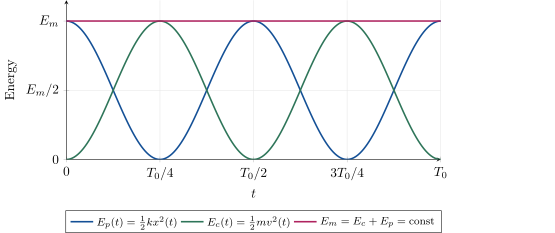
At any instant , the kinetic energy and the elastic potential energy (measured relative to equilibrium) are:
Since , their sum is constant and equal to the mechanical energy:
Moreover, since , the energies and are periodic functions of time of angular frequency , hence of period (and of frequency ): during one period of the motion, the energy is converted twice entirely from the potential form to the kinetic form and twice in the opposite direction.
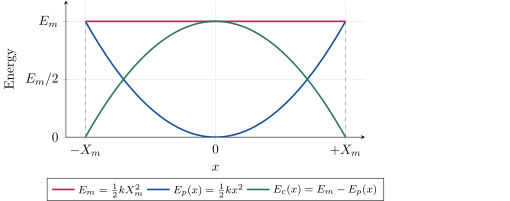
As functions of the elongation (graph of the energies as functions of position, figure below), the mechanical energy is represented by a horizontal line segment, the elastic potential energy by an arc of parabola passing through the origin, and the kinetic energy by the complementary inverted parabola:
Exercises of the chapter
- From the mass-spring system to arbitrary initial conditions solved
- Using an oscillogram of velocity and energy solved
- Vertical elastic pendulum: dynamic method and energy method solved
- Damped oscillations, forced resonance and energy balance at resonance solved
- Complete study of a torsion pendulum (LB-SG) solved
- Compound pendulum and simple pendulum: small oscillations (LB-SG) solved