Diffraction of light: wave aspect
Course · Physics (Grade 12 Life Sciences, Lebanon), chapter 7 · Lebanon, Grade 12 Life Sciences · the beginning of the chapter, the rest on Adloun
In the framework of geometrical optics studied in Grade 10 and Grade 11, light propagates in a straight line in any transparent, homogeneous and isotropic medium: a laser beam passing through a wide aperture projects onto a screen a light spot whose outline faithfully reproduces the geometry of the aperture. Yet, as soon as the width of the slit becomes very small — of the order of a tenth or a hundredth of a millimeter —, the beam suddenly spreads out in the direction perpendicular to the slit and produces on the screen a succession of light spots separated by zones of total extinction. This failure of rectilinear propagation is the diffraction of light: it reveals the wave nature of light radiation and sets the ultimate resolution limit of optical instruments (telescopes, microscopes, the human eye).
Curriculum: LB-SV
Required skills
- Show experimentally the failure of the principle of rectilinear propagation of light when it passes through an aperture or goes around a small obstacle.
- State the condition for a marked observation of the diffraction phenomenon ( of the order of magnitude of or up to a few hundred times ) and interpret this phenomenon using the Huygens-Fresnel principle.
- Describe the diffraction pattern produced by a thin straight slit of width illuminated with monochromatic light of wavelength (orientation perpendicular to the slit, central spot twice as wide as the secondary spots).
- Know and use the fundamental relation for the angular half-width (that is for small angles, with in radians).
- Establish and use the expression of the width of the central spot on a screen located at the distance from the diffracting slit.
- Apply Babinet's theorem to determine the diameter of a thin wire or of a hair by calibration of a curve .
- Describe the appearance of the diffraction pattern in white light (white center and iridescent edges, red being the most deviated) and through a circular aperture ().
7.1 Experimental evidence and wave aspect
7.1.1 Limits of geometrical optics
In geometrical optics, a light ray is modeled by an oriented straight line representing the direction of propagation of light energy. When a cylindrical beam from a monochromatic laser passes through a diaphragm of width of the order of a centimeter (), a light spot of the same width as the aperture is observed on a screen placed at a distance : light propagates in a straight line.
If the width of an adjustable vertical slit illuminated by this same laser beam is gradually reduced:
- as long as remains large compared with a millimeter, the width of the spot on the screen decreases in accordance with the laws of geometry;
- when becomes smaller than a few tenths of a millimeter (), the spot no longer shrinks: on the contrary, the beam diverges and spreads out horizontally (that is, perpendicular to the direction of the vertical slit);
- a symmetric pattern appears on the screen, made up of a very bright central bright spot, bordered on either side by secondary spots (or lateral fringes) of much lower intensity, separated by extinctions (dark zones where the light intensity is zero).
Diffraction is the change in the direction of propagation of a light wave when it meets an aperture or an obstacle of small dimension . Light ceases to propagate in a purely rectilinear way and penetrates into regions that geometrical optics predicted to be in shadow.
7.1.2 Other diffraction patterns: rectangular slit, wire, edge of a screen and grating
Experiment shows that diffraction occurs with any type of aperture or obstacle at least one transverse dimension of which is small enough (of the order of a tenth of a millimeter or less in visible optics):
- Rectangular aperture and square mesh: when a laser beam passes through a small rectangular aperture with sides and , diffraction takes place simultaneously along the two directions perpendicular to the sides of the rectangle, forming a cross of light spots (the spreading being greater along the direction of the narrower side). This is the phenomenon observed when looking at a distant light source through the fine mesh of a curtain or a veil.
- Thin obstacle (metal wire or hair): a thin wire placed in the path of the laser beam produces the same diffraction pattern as a slit of the same width (Babinet's theorem).
- Edge of an opaque screen (razor blade): near the boundary of the geometrical shadow, fine alternately bright and dark fringes appear parallel to the edge of the screen, while a faint light penetrates inside the geometrical shadow.
- Diffraction grating: a transparent plate with several hundred parallel, equally spaced lines per millimeter diffracts light in very intense preferred directions that depend on the wavelength .
In all cases, the diffracted wave keeps the same frequency and (in the same medium) the same wavelength as the incident wave: only the shape of the wave surfaces is modified after the aperture or the obstacle.
7.1.3 Huygens-Fresnel principle and observation condition
The diffraction phenomenon is a general property common to all waves (mechanical waves on the surface of water, sound waves, electromagnetic waves). Its observation with light proves that light has a wave character.
- Huygens' construction: every point of a wave surface reached by light at the instant behaves like a point secondary source emitting spherical wavelets that propagate forward with the speed of the wave in the medium. At a later instant , the new wave surface is the envelope of all these spherical wavelets of radius .
- Huygens-Fresnel interpretation: each point of an aperture illuminated by a monochromatic progressive light wave of frequency and wavelength emits, in all directions beyond the obstacle, a spherical wavelet of the same frequency and in phase with the incident wave at . The light amplitude at any point of the screen results from the coherent superposition (interference) of all these secondary wavelets.
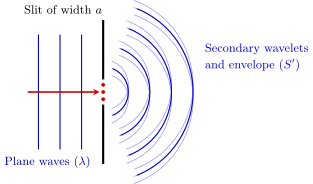
The diffraction of a wave of wavelength by an aperture or an obstacle of characteristic dimension is more marked the smaller the dimension is and the closer it is to the wavelength . In visible optics (, that is ), diffraction is clearly observable when:
This is why, in everyday life, sound waves () and radio waves () are strongly diffracted by doors, walls and hills, whereas visible light () does not go around these macroscopic obstacles.
In vacuum or in air (of index ), a monochromatic light radiation of frequency propagates at the speed with the wavelength:
In a transparent medium of refractive index , the frequency (imposed by the source) remains invariant, whereas the speed becomes and the wavelength decreases:
Exercises of the chapter
- Geometry of the diffraction pattern and width of the central spot solved
- Parametric study and determination of an unknown wavelength solved
- Immersion of the diffraction setup in a liquid of index solved
- Calibration curve and measuring the diameter of a hair solved
- Industrial quality control of the gauge of a copper wire by laser diffraction solved
- Diffraction by a circular aperture (Airy disk) and optical resolution solved