Particle aspect of light: the photoelectric effect
Course · Physics (Grade 12 Life Sciences, Lebanon), chapter 8 · Lebanon, Grade 12 Life Sciences · the beginning of the chapter, the rest on Adloun
At the end of the 19th century, the diffraction and interference experiments of Young and Fresnel, crowned by Maxwell's electromagnetic synthesis, seemed to have established once and for all that light is a continuous electromagnetic wave. Yet as early as 1887, Heinrich Hertz observed that a metal plate lit by ultraviolet light emits electric charges, and the measurements of Philipp Lenard (1902) revealed laws that flatly contradict classical physics: whether emission occurs and the energy of the emitted electrons do not depend on the intensity of the light but only on its frequency! In 1905, taking up the hypothesis of energy quanta introduced by Max Planck in 1900, Albert Einstein proposed a revolutionary idea that would earn him the Nobel Prize in Physics in 1921: light is made of indivisible grains of energy, the photons. This chapter studies the photoelectric effect, Einstein's photon theory, the operation of the vacuum photoelectric cell and wave-particle duality.
Curriculum: LB-SV
Required skills
- Describe Hertz's historical experiment (electroscope with a zinc plate) and state the experimental laws of the photoelectric effect (existence of a threshold frequency and of a threshold wavelength , instantaneousness, proportionality of the saturation current to the light power, independence of from the light power).
- Explain why the classical wave theory fails to account for the photoelectric effect.
- Define the photon and express its energy quantum , its momentum , as well as the work function of a metal.
- Establish and use Einstein's relation and interpret Millikan's straight line of universal slope .
- Describe the vacuum photoelectric cell, interpret its current-voltage characteristic , relate the stopping potential to through the kinetic energy theorem () and calculate the saturation current , the photon flux and the quantum efficiency .
- Express the wave-particle duality of light and of material particles (Louis de Broglie's relation ).
8.1 Experimental evidence and failure of the wave model
8.1.1 Definition and Hertz's historical experiment (zinc plate)
The (external) photoelectric effect is the emission of electrons by the surface of a material (generally a metal) when it is lit by electromagnetic radiation of suitable frequency. The electrons thus torn from the metal are called photoelectrons.
A freshly cleaned zinc plate is fixed on the plate of a gold-leaf electroscope, which shows the presence of an electric charge: as long as the system carries an electric charge, the movable leaf is repelled by the fixed rod; if the system discharges, the leaf falls back vertically. The zinc plate is lit with a mercury vapor lamp or an electric arc (sources rich in visible light and in ultraviolet radiation).
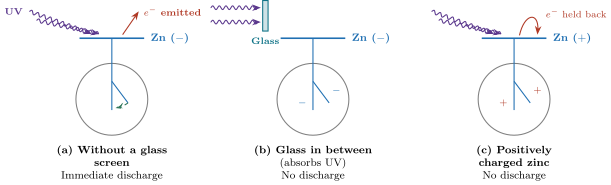
The experiment gives three fundamental observations:
- Negatively charged zinc, lit directly: the electroscope discharges at once. The light removes negative charges (electrons) from the plate, and the electrostatic repulsion of the negative plate drives them off into the air.
- Negatively charged zinc, with an ordinary glass plate in between: the electroscope no longer discharges. Now ordinary glass lets visible light through but absorbs ultraviolet radiation (whereas a quartz plate, transparent to UV, allows the discharge). For zinc, only ultraviolet radiations cause the photoelectric effect; a visible-light projector, even an extremely powerful one, produces no effect.
- Positively charged zinc, lit with UV: the electroscope does not discharge. The radiation never removes positive ions from the metal; as for the electrons ejected by the UV, they are immediately attracted back by the positive charge of the plate.
8.1.2 Experimental laws of the photoelectric effect and failure of the classical theory
Quantitative studies carried out on various metals (in particular the alkali metals such as cesium, potassium or sodium, which are sensitive from the visible range on) established the following four experimental laws:
- Frequency threshold law: for a given metal, photoelectric emission occurs only if the frequency of the incident radiation is greater than or equal to a threshold frequency characteristic of the metal (that is, a wavelength in vacuum less than or equal to the threshold wavelength ):
If (), no electron is emitted, whatever the incident light power.
- Instantaneousness of the emission: when , the emission of electrons starts almost instantly (delay less than ) as soon as the light is on, even if the light intensity is extremely low.
- Proportionality to the light flux: for a given monochromatic radiation of frequency , the number of electrons emitted per second (hence the saturation current ) is directly proportional to the light power received .
- Law of the maximum kinetic energy: the maximum kinetic energy of the emitted photoelectrons is independent of the light power ; it depends only on the nature of the metal and increases linearly with the frequency of the incident radiation.
In Maxwell's classical wave model, the energy of a light wave is spread continuously over the whole wavefront and is proportional to the square of the amplitude of the electric field (that is, to the illuminance or power per unit area). According to this model:
- a very intense light should give a large energy to the electrons of the metal and tear them off whatever its frequency (there should be no threshold frequency );
- the maximum kinetic energy should increase with the light power;
- under a very weak illuminance, an atom should gradually accumulate the energy diluted over the wavefront for several minutes or several hours before it can release an electron (the emission should not be instantaneous).
These three classical predictions are in complete contradiction with experiment.
Exercises of the chapter
- The photon in the electromagnetic spectrum and the zinc-plate experiment solved
- Millikan's straight line and experimental determination of the Planck constant solved
- Change in the maximum speed and in the stopping potential when the wavelength changes solved
- Characteristic of a photoelectric cell, saturation current and quantum efficiency solved
- Magnetic spectrometry of photoelectrons solved
- Wave-particle duality: interference photon by photon and de Broglie wave solved