The atom and the quantization of energy
Course · Physics (Grade 12 Life Sciences, Lebanon), chapter 9 · Lebanon, Grade 12 Life Sciences · the beginning of the chapter, the rest on Adloun
When the light emitted by the incandescent filament of an ordinary lamp is dispersed with a prism or a grating, a continuous spectrum is observed, containing all the colors of the rainbow without interruption. On the other hand, the light emitted by a bulb containing an atomic gas at low pressure excited by an electric discharge (mercury, sodium or hydrogen vapor) contains only a small number of very narrow monochromatic radiations, separated by wide dark regions: it is a line spectrum, a true fingerprint of the chemical element. Why does an atom emit and absorb only certain strictly determined wavelengths? In 1913, the Danish physicist Niels Bohr solved this riddle by introducing the quantization of the energy levels of the atom, opening the way to modern quantum physics and to lasers.
Curriculum: LB-SV
Required skills
- State Bohr's postulates (stationarity of the quantized energy levels and energy transition relation ) and prove the expressions of the quantized radius () and of the energy () of the hydrogen atom.
- Use the energy-level diagram of the hydrogen atom: identify the ground state (), the excited states (), the ionized state (, ) and the ionization energy.
- Characterize the five spectral series of the hydrogen atom (Lyman in the UV, Balmer in the visible, Paschen, Brackett and Pfund in the IR), establish the Rydberg formula and calculate the extreme wavelengths ( and series limit ) of each series.
- Distinguish the conditions for exciting an atom by resonant absorption of a photon ( exactly, otherwise by photoionization if ) and by inelastic collision with an electron or another atom ().
9.1 Bohr's postulates and the quantization of energy
9.1.1 Statement of Niels Bohr's postulates (1913)
To explain the stability of the atom and its line spectra, Niels Bohr stated in 1913 two fundamental postulates that introduce the Planck constant into the mechanics of the atom.
- First postulate (quantization of the stationary states): The atom can exist only in a discrete sequence of well-defined states called stationary states (or energy levels), characterized by quantized values of its total energy: As long as it remains in a stationary state of energy , the atom emits no radiation and its energy remains strictly constant.
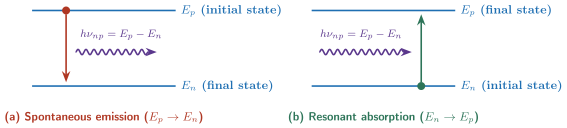
- Second postulate (electronic transitions and Bohr's relation): The atom emits or absorbs a photon only when it makes a sudden transition (“quantum jump”) between two energy levels and (with ):
- Emission transition (, de-excitation): in passing from a higher level to a lower level , the atom emits a photon of energy:
- Absorption transition (, excitation): in passing from a lower level to a higher level , the atom absorbs a photon whose energy must be exactly equal to the gap between the two levels:
9.1.2 Energy vocabulary of a level diagram
In the energy diagram of an atom:
- The ground state () is the state of lowest energy . It is the most stable state, in which the atom at rest is spontaneously found at ordinary temperature.
- The excited states () are all the energy levels above the ground state (). These states are unstable (very short lifetime, of the order of ): the excited atom spontaneously returns to the ground state directly or through successive cascades, emitting one or several photons.
- The ionized state () corresponds to the removal of the electron, now infinitely far from the nucleus and at rest: by convention, this state is chosen as the zero of energy (). All the bound states of the atom therefore have a negative energy ().
- The ionization energy of the atom (taken in its ground state) is the minimum energy that must be supplied to ionize it from :
Exercises of the chapter
- Energy-level diagram of hydrogen and Balmer series solved
- Comparing the Lyman, Balmer and Paschen series and Ritz combination principle solved
- Counting the emission lines after a selective excitation solved
- Excitation by photon versus excitation by electron collision on a cesium atom solved
- Hydrogen-like ions and : astrophysical spectroscopy (going further, beyond the LS syllabus) solved
- Synthesis problem: using a spectral series, recoil speed of the atom and photoelectric effect solved