Chemistry (Grade 11 Humanities, Lebanon) · Chapter 4 · Tutorial exercise
A string of beads
General characteristics of synthetic polymers · A. Giant molecules · level 2
Statement
The diagram below shows how a macromolecule is built. Four elements are marked in it by the letters A, B, C and D. The letter B refers to the chemical transformation represented by the arrow.
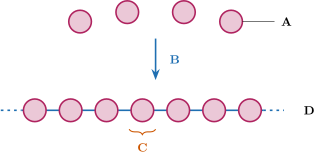
1) What does each of the separate beads, marked with the letter A, represent?
2) What is transformation B called?
3) What does bead C, marked with a brace, represent?
4) What does the long chain D represent?
5) The monomer used is called propylene. Give the name and the abbreviation of the polymer obtained.
6) A macromolecule of this polymer contains repeating units. How many monomer molecules were needed to build it?
7) A model of this macromolecule is made by threading beads, one per repeating unit. Calculate the length of the string, in meters.
Solution
1) A monomer: a small molecule, able to link to other identical molecules.
2) It is polymerization.
3) A repeating unit: the group of atoms that is repeated all along the chain.
4) A macromolecule of the polymer: a very long chain, which continues on both sides, as the dotted lines indicate.
5) “Poly” is placed in front of the name of the monomer: it is polypropylene, abbreviated PP.
6) Each repeating unit comes from one monomer molecule: molecules of propylene were needed.
7) The length of the string is
Key takeaway: identical monomers link end to end; the repeating unit is the bead that is repeated, the polymer is the whole string.
Similar exercises
- Natural or synthetic? solved
- The right name, the right abbreviation solved
- Three structures, three behaviors solved
- A plastic bucket or a steel bucket? solved
- Reading identification codes solved
The course of the chapter · All the exercises of the chapter