Chemistry (Grade 11 Humanities, Lebanon) · Chapter 4 · Tutorial exercise
Three structures, three behaviors
General characteristics of synthetic polymers · B. Families, qualities and codes · level 2
Statement
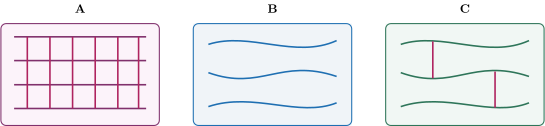
The three diagrams below represent the way the chains are arranged in three plastics, labeled A, B and C. The horizontal or wavy lines are the chains; the vertical lines are bridges that link the chains to one another.
1) In which of the three materials are the chains separate from one another?
2) Which of the three materials is a thermoplastic? How does it behave when heated?
3) Which one is a thermoset? How does it behave when heated?
4) Which one is an elastomer? How does it behave when stretched?
5) A bucket, a tire and a saucepan handle are to be made. Assign to each object the suitable material A, B or C.
6) Which of these three objects can, once worn out, be melted to make a new object?
Solution
1) In material B: no bridge links its chains.
2) B is a thermoplastic. When heated, it softens and then melts, because its chains can slide over one another; when cooled, it hardens again.
3) A is a thermoset: its chains are welded by a great many bridges. When heated, it does not melt; if overheated, it blackens and is destroyed.
4) C is an elastomer: its flexible chains are linked by only a few bridges. When stretched, it lengthens; when let go, it returns to its shape.
5) The bucket: material B (thermoplastic, easy to mold). The tire: material C (elastomer). The saucepan handle: material A (thermoset, it stays hard in the heat).
6) The bucket: only a thermoplastic melts and can be molded again.
Key takeaway: no bridges, the material melts; many bridges, it never melts; a few bridges, it is elastic.
Similar exercises
- A string of beads solved
- The right name, the right abbreviation solved
- A plastic bucket or a steel bucket? solved
- Reading identification codes solved
- Problem: the plastics of a kitchen solved
The course of the chapter · All the exercises of the chapter