Chemistry (Grade 11 Humanities, Lebanon) · Chapter 6 · Tutorial exercise
Four pictograms
Pesticides: classification and toxicity · B. Measuring toxicity · level 2
Statement
Here, in simplified drawings, are four hazard pictograms that can be found on the packaging of a pesticide.
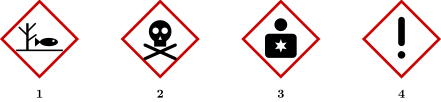
1) Which of these pictograms signals a product that can kill, even at a low dose?
2) Which one signals a harmful or irritating product?
3) Which one signals a serious long-term danger to health?
4) Which one signals a product dangerous to the environment?
5) Which ones concern acute toxicity? Which one concerns chronic toxicity?
6) One product has an of , another of . On whose packaging would pictogram 2 be expected? Justify.
7) Two signal words accompany the pictograms: “Warning” and “Danger”. Which one designates the most dangerous products?
Solution
1) Pictogram 2, the skull and crossbones.
2) Pictogram 4, the exclamation mark.
3) Pictogram 3, the health hazard silhouette.
4) Pictogram 1, the tree and the fish.
5) Pictograms 2 and 4 concern acute toxicity: the product acts quickly. Pictogram 3 concerns chronic toxicity: the effects appear in the long term.
6) On that of the product whose is : this value, below , is that of an extremely hazardous product, which can kill at a very low dose.
7) The word “Danger”.
Key takeaway: hazard pictograms can be understood at a glance; the skull and crossbones signals the products whose is the smallest.
Similar exercises
- Three entry doors solved
- A laboratory test solved
- Comparing, classifying, calculating solved
- The mistakes of a morning of treatment solved
- Problem: a treatment in a tomato greenhouse solved
The course of the chapter · All the exercises of the chapter