Chemistry (Grade 11 Humanities, Lebanon) · Chapter 7 · Tutorial exercise
Flies that no longer die
Pesticides and the environment · A. Resistance and the fate of pesticides · level 1 (application)
Statement
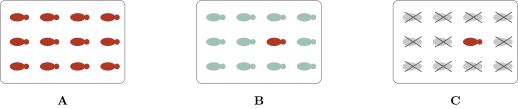
In a cowshed, the same insecticide has been used against flies for several years. It has become ineffective. The three drawings A, B and C below, given in random order, tell what happened. A light insect is sensitive to the insecticide, a dark insect is resistant, an insect crossed out is dead.
1) What is an insect resistant to an insecticide?
2) Which of the three drawings shows the population before the first treatment? How many resistant insects does it contain?
3) Which one shows the population just after a treatment? Which insects survived?
4) Which one shows the population a few generations later?
5) Put the three drawings back in order.
6) Did the insecticide transform sensitive insects into resistant insects? Justify.
7) Why does resistance become established quickly in flies?
Solution
1) An insect that survives a dose of this product that kills the other insects of its species.
2) Drawing B: it shows sensitive insects and a single resistant insect.
3) Drawing C: the sensitive insects are dead, only the resistant insect has survived.
4) Drawing A: all the insects are resistant.
5) The order is: B, then C, then A.
6) No. The resistant insect existed before the treatment. The insecticide only sorted them: it killed the sensitive ones and made room for the resistant one, which reproduced. The treatment is said to select the resistant insects.
7) Because flies reproduce very quickly: several generations follow one another in a single year.
Key takeaway: the insecticide does not create resistance, it selects it: it kills the sensitive ones, and the resistant ones reproduce.
Similar exercises
- Two insecticides in the soil solved
- The journey of a pesticide solved
- DDT along a food chain solved
- Weighing the pros and cons solved
- Ladybugs in the greenhouse solved
The course of the chapter · All the exercises of the chapter