Life Sciences (Grade 10, Lebanon) · Chapter 1 · Tutorial exercise
Engelmann's experiment
Autotrophy and photosynthesis · B. The chloroplast and gas exchange · level 2
Statement
At the end of the 19th century, the physiologist Theodor Engelmann observed under the microscope a filamentous green alga, spirogyra. Each of its cells contains a ribbon-shaped chloroplast coiled in a spiral. Engelmann placed the alga in a drop of water containing motile bacteria, which always gather where the water is richest in oxygen. The preparation is first left in darkness: the bacteria are distributed evenly everywhere. He then illuminated a precise point of the cell with a very small spot of light.
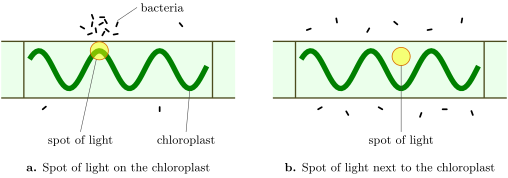
- Describe the distribution of the bacteria in situation a.
- Describe the distribution of the bacteria in situation b.
- State what the gathering of the bacteria at one point reveals.
- Deduce from the comparison of situations a and b the part of the cell that releases oxygen in the light.
- Explain the value of the observation made in darkness.
Solution
- In situation a, most of the bacteria are gathered against the cell, very close to the spot of light; only a few remain scattered.
- In situation b, the bacteria are scattered evenly all around the cell; they do not gather near the spot of light.
- The bacteria gather where the water is richest in oxygen. A gathering of bacteria therefore signals a place where oxygen is released.
- Oxygen is released when the light falls on the chloroplast (situation a), but not when it falls on a part of the cell without a chloroplast (situation b). It is therefore the illuminated chloroplast that releases the oxygen: it is the site of photosynthesis.
- In darkness, the bacteria are distributed evenly everywhere: the alga then releases no oxygen. This observation serves as a control; it shows that the gathering of the bacteria is indeed due to the illumination of the chloroplast.
What the exercise establishes: the illuminated chloroplast is the place where oxygen is released.
Similar exercises
- A partly covered variegated leaf solved
- Three bell jars to test carbon dioxide solved
- Labeling an elodea leaf cell solved
- The oxygen of a suspension of algae solved
- The bubbles of elodea solved
The course of the chapter · All the exercises of the chapter