Life Sciences (Grade 10, Lebanon) · Chapter 1 · Tutorial exercise
Labeling an elodea leaf cell
Autotrophy and photosynthesis · B. The chloroplast and gas exchange · level 2
Statement
The diagram below was made from the observation of an elodea leaf cell under the light microscope.
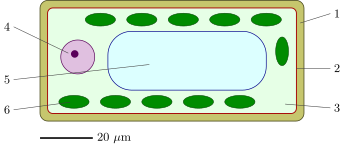
- Give the label corresponding to each of the numbers 1 to 6.
- Propose a complete title for this diagram.
- Justify the name “chlorophyllic cell” given to this cell.
- State in which part of the cell the chloroplasts are found.
- The cell is five times longer than the scale bar. Calculate its actual length.
Solution
- The labels are: 1, the cell wall; 2, the plasma membrane; 3, the cytoplasm; 4, the nucleus; 5, the vacuole; 6, a chloroplast.
- A complete title states the object and the means of observation: “Diagram of a chlorophyllic cell of an elodea leaf observed under the light microscope”.
- This cell contains chloroplasts, green organelles that contain chlorophyll: this is why it is called chlorophyllic.
- The chloroplasts are found in the cytoplasm, that is, in the thin layer between the plasma membrane and the vacuole. There are none in the vacuole or in the nucleus.
- The scale bar represents . The cell is five times longer: its actual length is , that is, one tenth of a millimeter.
What the exercise establishes: the labeled diagram of the chlorophyllic cell and the reading of a scale.
Similar exercises
- A partly covered variegated leaf solved
- Three bell jars to test carbon dioxide solved
- Engelmann's experiment solved
- The oxygen of a suspension of algae solved
- The bubbles of elodea solved
The course of the chapter · All the exercises of the chapter