Life Sciences (Grade 10, Lebanon) · Chapter 1 · Tutorial exercise
The bubbles of elodea
Autotrophy and photosynthesis · B. The chloroplast and gas exchange · level 3 (hard)
Statement
An elodea sprig is placed under an inverted funnel, in a beaker filled with water. A test tube full of water caps the funnel. When the sprig is illuminated, gas bubbles escape from its cut stem and rise into the tube.
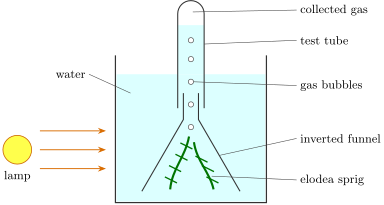
Part A. The bubbles released in one minute are counted in four situations. Water that has been boiled then cooled has lost its dissolved gases: it contains almost no carbon dioxide. Sodium hydrogen carbonate, dissolved in the water, supplies it with carbon dioxide.
| Situation | Water of the beaker | Illumination | Bubbles per minute |
|---|---|---|---|
| 1 | tap water | light | 12 |
| 2 | tap water | darkness | 0 |
| 3 | water boiled then cooled | light | 0 |
| 4 | tap water with added hydrogen carbonate | light | 30 |
Part B. The gas collected in the tube of situation 4 relights a wooden splint whose tip is only glowing.
Part C. A leaf is taken from the sprig of situation 1 and a leaf from that of situation 2. After treatment with iodine solution, they are observed under the microscope: the chloroplasts of the first contain blue-black grains, those of the second contain none.
- Compare situations 1 and 2, then conclude.
- Compare situations 1 and 3, then conclude.
- Explain the result of situation 4.
- Identify the collected gas using part B.
- Name the substance detected in the chloroplasts in part C.
- Relate the results of parts A and C for situations 1 and 2.
- Write the overall equation of photosynthesis.
- Write a short summary that states, for an illuminated elodea cell, what enters, what is made, what is released and the place where it is made.
Solution
- Situations 1 and 2 differ only in illumination. The illuminated sprig releases 12 bubbles per minute; in darkness, it releases none. The release of gas therefore requires light.
- Situations 1 and 3 are both illuminated; they differ only in the presence of carbon dioxide in the water. Without carbon dioxide, the sprig releases no bubbles. The release of gas therefore also requires carbon dioxide.
- In situation 4, the water is richer in carbon dioxide than in situation 1, and the release goes from 12 to 30 bubbles per minute. The more carbon dioxide the plant has available, the more intense the release of gas: carbon dioxide is indeed used by the illuminated plant.
- A glowing splint that relights reveals the presence of oxygen. The gas released by the illuminated elodea is therefore oxygen.
- Iodine solution colors starch blue-black. The blue-black grains observed in the chloroplasts are therefore starch grains.
- In situation 1, the illuminated sprig releases oxygen and its chloroplasts contain starch. In situation 2, in darkness, there is neither release of oxygen nor starch. The release of oxygen and the synthesis of starch therefore go together: they are two manifestations of the same phenomenon, photosynthesis, which takes place only in the light.
- The overall equation of photosynthesis is: It takes place in the light and in the presence of chlorophyll; is glucose.
- An illuminated elodea cell takes up carbon dioxide dissolved in the water and uses water: these are mineral matter. Thanks to light energy, its chloroplasts make an organic matter, glucose, stored on the spot as starch grains. At the same time, the cell releases oxygen. This making takes place in the chloroplasts, which contain chlorophyll: this is photosynthesis, by which the plant, an autotroph, produces its organic matter from mineral matter.
What the exercise establishes: gather into a single summary the conditions, the gas exchange, the product and the site of photosynthesis.
Similar exercises
- A partly covered variegated leaf solved
- Three bell jars to test carbon dioxide solved
- Labeling an elodea leaf cell solved
- Engelmann's experiment solved
- The oxygen of a suspension of algae solved
The course of the chapter · All the exercises of the chapter