Life Sciences (Grade 10, Lebanon) · Chapter 1 · Direct application of the course
The carbon dioxide of a closed chamber
Autotrophy and photosynthesis · level 2
Statement
A potted plant is enclosed in an airtight glass chamber fitted with a carbon dioxide probe. The content of the air is expressed in ppm (parts per million); ordinary air contains about 400 ppm. The chamber is illuminated for 20 min, then placed in darkness for 10 min.
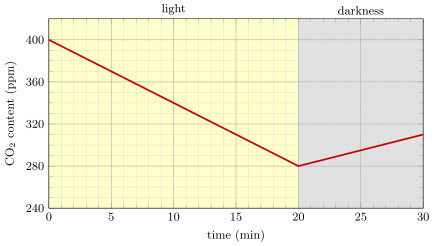
- Read the content at times 0, 20 and 30 min.
- Calculate the change in content per minute during the light period.
- Interpret the change observed in the light.
- Calculate the change in content per minute during the dark period, then interpret it.
- Predict the direction of change of the oxygen content of the chamber during each of the two periods.
- If the illumination were extended for a very long time, the content of the chamber would become very low. Predict the consequence for the synthesis of starch by the leaves.
Solution
- One reads 400 ppm at 0 min, 280 ppm at 20 min and 310 ppm at 30 min.
- In the light, the content goes from 400 to 280 ppm in 20 min:
- In the light, the content of the air decreases: the plant takes up carbon dioxide. This uptake in the light is one of the chlorophyllic gas exchanges; the carbon dioxide taken up is used for photosynthesis.
- In darkness, the content goes from 280 to 310 ppm in 10 min:
The content increases: the plant releases carbon dioxide. In darkness, photosynthesis has stopped; only the gas exchange of respiration remains.
- In the light, the plant releases oxygen: the oxygen content increases. In darkness, the plant takes up oxygen for its respiration: the oxygen content decreases. Oxygen therefore varies in the opposite direction to carbon dioxide.
- Carbon dioxide is necessary for the synthesis of starch. If the air of the chamber contains almost none left, the leaves, although illuminated, can no longer make starch: photosynthesis stops for lack of carbon dioxide.
Similar exercises
- The bubbles of elodea solved
- Autotrophic or heterotrophic? solved
- Labeling the ultrastructure of a chloroplast solved
- The starch of a leaf over twenty-four hours solved
- Priestley's bell jars solved
The course of the chapter · All the exercises of the chapter