Life Sciences (Grade 10, Lebanon) · Chapter 1 · Tutorial exercise
The oxygen of a suspension of algae
Autotrophy and photosynthesis · B. The chloroplast and gas exchange · level 2
Statement
A suspension of unicellular green algae is placed in a closed chamber. A probe measures the oxygen concentration of the water. The chamber is in darkness from 0 to 4 min, illuminated from 4 to 10 min, then in darkness again from 10 to 14 min.
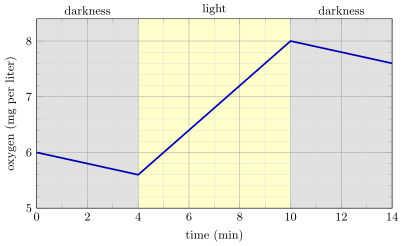
- Read the oxygen concentration at times 0 min, 4 min and 10 min.
- Describe the change in oxygen concentration during each of the three periods.
- Calculate the change in oxygen concentration per minute during the first dark period.
- Calculate the change in oxygen concentration per minute during the light period.
- Name the phenomenon responsible for the change observed in darkness.
- State how the carbon dioxide concentration would change during the light period.
- Assume that respiration continues in the light with the same intensity as in darkness. Determine the amount of oxygen actually produced by photosynthesis, per liter and per minute.
Solution
- On the graph one reads: per liter at 0 min, per liter at 4 min and per liter at 10 min.
- From 0 to 4 min, in darkness, the oxygen concentration decreases. From 4 to 10 min, in the light, it increases. From 10 to 14 min, in darkness, it decreases again.
- During the first dark period, the concentration goes from to per liter in 4 min: The algae consume of oxygen per liter every minute.
- During the light period, the concentration goes from to per liter in 6 min: The water gains of oxygen per liter every minute.
- In darkness, the algae take up oxygen: this is respiration.
- In the light, the algae take up carbon dioxide: its concentration would decrease, unlike that of oxygen.
- In the light, respiration still consumes of oxygen per liter per minute. For the water to gain per liter per minute in spite of this, photosynthesis must produce: The release measured in the light is therefore a little lower than the actual production, because respiration masks part of it.
What the exercise establishes: read a recording, calculate a change per minute, distinguish the exchange of respiration from that of photosynthesis.
Similar exercises
- A partly covered variegated leaf solved
- Three bell jars to test carbon dioxide solved
- Labeling an elodea leaf cell solved
- Engelmann's experiment solved
- The bubbles of elodea solved
The course of the chapter · All the exercises of the chapter