Life Sciences (Grade 10, Lebanon) · Chapter 2 · Tutorial exercise
A summer day in a greenhouse
Supplying the plant with raw materials · B. Crude sap and stomata · level 3 (hard)
Statement
In a coastal greenhouse, two tomato plants of the same size are followed during a summer day. Plant 1 is watered every day; plant 2 has not been watered for five days.
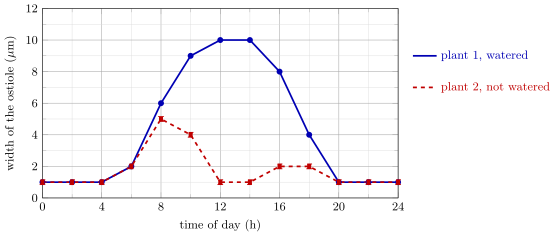
Part A. The mean width of the ostiole of the stomata of both plants is measured every two hours. The Sun rises around 6:00 and sets around 19:00.
Part B. The carbon dioxide absorbed by a leaf of each plant is measured at three times of the day (in arbitrary units).
| Time | 8:00 | 14:00 | 18:00 |
|---|---|---|---|
| Plant 1, watered | 6 | 10 | 4 |
| Plant 2, not watered | 5 | 1 | 2 |
Part C. At 14:00, the leaves of plant 2 are limp and drooping. This plant is then watered in the evening: the next morning, its leaves are firm and spread out again.
- Describe how the width of the ostiole of plant 1 changes over the twenty-four hours.
- Relate this change to the alternation of day and night.
- Compare the width of the ostiole of the two plants at 8:00, then at 14:00.
- Explain the closing of the stomata of plant 2 in broad daylight.
- Show that this closing is advantageous for plant 2.
- Relate, for plant 2, the results of part B to those of part A.
- Deduce the consequence of this closing for the photosynthesis of plant 2.
- Describe the path followed by the irrigation water, from the soil to the leaves of plant 2, specifying what makes it rise (part C).
- Write a short summary explaining why a well-irrigated tomato plant produces more organic matter.
Solution
- In plant 1, the ostiole is almost closed from 0:00 to 4:00 (width of ). It opens from 6:00, reaches its maximum width, , between 12:00 and 14:00, then gradually closes again; it is almost closed again from 20:00.
- The stomata of plant 1 are open during the day, between sunrise and sunset, and closed during the night. The opening of the stomata therefore depends on light.
- At 8:00, the ostioles of the two plants have almost the same width: for plant 1 and for plant 2. At 14:00, the ostiole of plant 1 is wide open (), whereas that of plant 2 is almost closed ().
- Plant 2 is no longer watered: its roots no longer find enough water in the soil to replace the water the leaves lose. The guard cells lose water, they are less swollen, come closer to each other, and the ostiole closes, although the leaf is illuminated.
- Water vapor leaves the leaf through the ostioles. By closing its stomata during the hottest hours, plant 2 greatly reduces its transpiration: it saves the little water it has left.
- At 8:00, the stomata of plant 2 are open () and the leaf absorbs 5 units of carbon dioxide, almost as much as plant 1. At 14:00, its stomata are almost closed () and absorption drops to 1 unit, versus 10 for plant 1. The absorption of carbon dioxide follows the opening of the stomata: carbon dioxide enters the leaf through the ostioles.
- Carbon dioxide is a raw material of photosynthesis. When the stomata of plant 2 are closed, the chlorophyllic cells receive almost none of it: photosynthesis slows down sharply, even though light is at its most intense.
- The irrigation water joins the soil solution. It is absorbed, with the mineral ions, by the root hairs of the root hair zone of the roots, which it enters by osmosis. It crosses the cortex of the root from cell to cell and reaches the xylem vessels of the central cylinder. It then rises, as crude sap, in the xylem vessels of the stem, then in the veins of the leaves. This upward movement is due to root pressure and above all to transpiration pull, created by transpiration. Once in the leaves, the water swells the cells again: the leaves become firm again.
- A well-irrigated plant absorbs through its roots all the water it needs. Its guard cells stay turgid and its stomata stay open throughout the day. Carbon dioxide then enters the leaves freely, and the crude sap, which rises without interruption, brings them water and mineral ions. The chlorophyllic cells thus have, in the light, all their raw materials: photosynthesis is intense and the plant makes a lot of organic matter. A plant that lacks water closes its stomata, receives less carbon dioxide and produces less.
What the exercise establishes: relate the absorption of water, the opening of the stomata and the supply of carbon dioxide in a single line of reasoning.
Similar exercises
- Onion cells in salty water solved
- The ions of a nutrient solution solved
- The measurements of a potometer solved
- Recognizing xylem vessels solved
- Counting the stomata of a leaf solved
The course of the chapter · All the exercises of the chapter