Life Sciences (Grade 10, Lebanon) · Chapter 2 · Tutorial exercise
Counting the stomata of a leaf
Supplying the plant with raw materials · B. Crude sap and stomata · level 2
Statement
A strip of epidermis is peeled off each of the two faces of a bean leaf and observed under the microscope. The diagram represents what is seen of the lower epidermis in a field of view whose area is . In a field of the same area, the upper epidermis shows only 2 stomata.
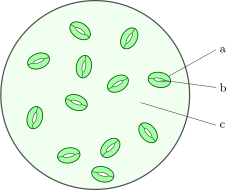
- Name elements a, b and c.
- Count the stomata visible in the field of view of the lower epidermis.
- Calculate the number of stomata per square millimeter on the lower face.
- Calculate the number of stomata per square millimeter on the upper face.
- The leaf has an area of on each face. Calculate the total number of stomata on its lower face.
- Compare the two faces, then suggest an advantage of this distribution for the plant.
- Predict which of the two faces must be coated with petroleum jelly to stop almost all the transpiration of this leaf.
Solution
- Element a is a guard cell; element b is the ostiole, the opening of the stoma; element c is an epidermal cell.
- 12 stomata are counted in the field of view.
- There are 12 stomata on . On , an area twenty times larger:
- On the upper face, there are 2 stomata on :
- The area of the leaf is . The number of stomata on the lower face is: that is, nearly a million stomata on a single face.
- The lower face bears six times more stomata than the upper face (240 versus 40 per square millimeter). The upper face receives the sun directly and heats up more; the lower face stays in the shade. Stomata located mainly on the lower face let carbon dioxide in while losing less water.
- Water vapor leaves the leaf through the ostioles of the stomata. Since most of the stomata are on the lower face, it is this face that must be coated with petroleum jelly to stop almost all transpiration.
What the exercise establishes: label a stoma seen face-on and calculate a stomatal density.
Similar exercises
- Onion cells in salty water solved
- The ions of a nutrient solution solved
- The measurements of a potometer solved
- Recognizing xylem vessels solved
- A summer day in a greenhouse solved
The course of the chapter · All the exercises of the chapter