Life Sciences (Grade 10, Lebanon) · Chapter 2 · Direct application of the course
Labeling a root hair
Supplying the plant with raw materials · level 1 (application)
Statement
The following diagram was made from the observation of a fragment of young root under the light microscope.
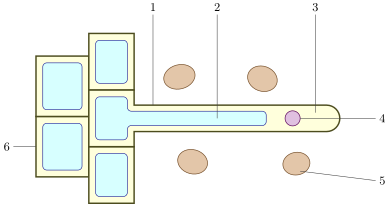
- Give the label corresponding to each of the numbers 1 to 6.
- Name the zone of the root from which this fragment was taken.
- Pick out from the diagram two features of the root hair that favor the absorption of water, justifying each one.
- Explain the absence of chloroplasts in this cell.
- A root hair is mm long and m in diameter. Calculate how many times greater its length is than its diameter.
Solution
- The labels are: 1, the cell wall; 2, the vacuole; 3, the cytoplasm; 4, the nucleus; 5, a soil particle; 6, a cortex cell.
- Root hairs are found only in the root hair zone of the root: the fragment comes from this zone.
- The root hair is very elongated: its contact surface with the soil solution is large, and it works its way between the soil particles. Its cell wall is thin and has no waterproof coating: water and ions cross it easily. Its large vacuole can also be noted, whose content, more concentrated than the soil solution, makes water enter by osmosis.
- The root lives in the soil, in darkness: it does not carry out photosynthesis. Its cells, including the root hair, have no chloroplasts.
- Both dimensions are expressed in the same unit: m. The ratio is:
The hair is eighty times longer than it is wide: it is an extremely slender cell.
Similar exercises
- A summer day in a greenhouse solved
- The water absorbed by a bean plant solved
- The rise of a dye in stems solved
- The mass of a potted plant solved
- Four leaves and some petroleum jelly solved
The course of the chapter · All the exercises of the chapter