Life Sciences (Grade 10, Lebanon) · Chapter 2 · Tutorial exercise
Recognizing xylem vessels
Supplying the plant with raw materials · B. Crude sap and stomata · level 2
Statement
The diagram represents four vessels observed under the microscope in a longitudinal section of a stem. The brown parts are thickenings of the wall.
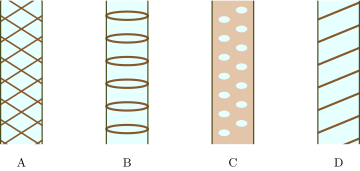
Vessels of types B and D are observed mainly in young organs, still growing longer; vessels of types A and C are found in organs that have finished growing longer.
- Name each of the four types of vessels.
- Name the substance that forms the thickenings of the wall.
- Specify what a functioning vessel contains.
- A vessel is made of dead cells. State what these cells have lost, then the advantage this offers.
- Explain the benefit, for the plant, of the thickenings of the wall.
- Suggest an explanation for the presence of vessels B and D in organs that are still growing longer.
Solution
- Vessel A, whose thickenings form a network, is a reticulate vessel. Vessel B, with rings, is an annular vessel. Vessel C, whose wall is thickened everywhere except in small light areas, is a pitted vessel. Vessel D, with a spiral thickening, is a spiral vessel.
- The thickenings are made of lignin, a rigid substance.
- A functioning vessel contains crude sap, that is, water and dissolved mineral ions, which rises from the roots toward the leaves.
- The cells of a vessel have lost their nucleus and their cytoplasm; the cross walls that separated them have also disappeared. The vessel is then an empty, continuous tube, in which nothing slows down the passage of the crude sap.
- Lignin makes the wall rigid. When the leaves transpire, the sap is pulled upward; without reinforcement, the tube would collapse like a straw that is too soft when one sucks through it. The thickenings keep the vessel open.
- In annular and spiral vessels, the wall stays thin between the rings or between the turns of the spiral. It can therefore stretch: the rings move apart, the spiral extends like a spring, and the vessel follows the lengthening of the organ without breaking. Reticulate and pitted vessels, reinforced over almost their whole wall, can no longer stretch: they suit organs that are no longer growing longer.
What the exercise establishes: recognize the patterns of the vessels and relate the structure of the vessel to the conduction of the crude sap.
Similar exercises
- Onion cells in salty water solved
- The ions of a nutrient solution solved
- The measurements of a potometer solved
- Counting the stomata of a leaf solved
- A summer day in a greenhouse solved
The course of the chapter · All the exercises of the chapter