Life Sciences (Grade 10, Lebanon) · Chapter 2 · Direct application of the course
The mass of a potted plant
Supplying the plant with raw materials · level 2
Statement
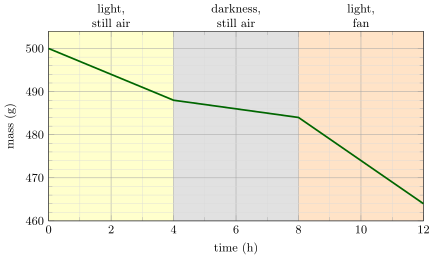
A well-watered potted plant is prepared as follows: the pot and the soil are enclosed in a watertight plastic bag, tied around the base of the stem. The whole is placed on a balance and its mass is recorded for twelve hours, under three successive conditions.
- Explain why the pot and the soil are enclosed in a plastic bag.
- Read the mass of the whole at times 0, 4, 8 and 12 h.
- Calculate the mass lost per hour during each of the three periods.
- Name the phenomenon responsible for this loss of mass and state in what form the water leaves the plant.
- Explain the difference between the first and the second period.
- Explain the difference between the first and the third period.
Solution
- The bag prevents the water of the soil from evaporating. In this way, any loss of mass measured comes from the water lost by the plant itself, and not by the soil of the pot.
- The readings are 500 g at 0 h, 488 g at 4 h, 484 g at 8 h and 464 g at 12 h.
- From 0 to 4 h: g per hour. From 4 to 8 h: g per hour. From 8 to 12 h: g per hour.
- The plant loses water through its leaves: this is transpiration. The water leaves the plant in the vapor state.
- In darkness, the plant loses three times less water than in the light (1 g per hour instead of 3). Water vapor leaves through the stomata; now the stomata, open in the light, close in darkness. Transpiration then becomes very low.
- In the light, the plant loses more water in front of the fan (5 g per hour) than in still air (3 g per hour). The stomata are open in both cases, but the draft carries away the water vapor as it leaves the leaves: transpiration is more intense.
Similar exercises
- A summer day in a greenhouse solved
- The water absorbed by a bean plant solved
- Labeling a root hair solved
- The rise of a dye in stems solved
- Four leaves and some petroleum jelly solved
The course of the chapter · All the exercises of the chapter