Life Sciences (Grade 10, Lebanon) · Chapter 3 · Direct application of the course
A leaf's night
What happens to the products of photosynthesis · level 2
Statement
The mass of starch contained in two leaves of the same bean plant is followed during a night, from 18:00 to 6:00. Leaf A is intact. At 18:00, the petiole of leaf B received a jet of scalding steam that killed its living cells, without cutting it. Both leaves stayed firm all night.
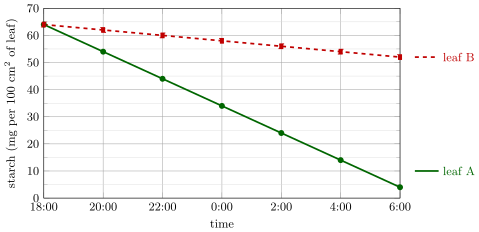
- Read the mass of starch of each leaf at 18:00 and at 6:00.
- Calculate the mass of starch lost by each leaf during the night.
- Explain the small decrease observed in leaf B.
- Deduce the mass of starch that left leaf A during the night, per 100 cm.
- Specify in what form, and through which tissue, this organic matter left leaf A.
- Explain why the jet of steam prevents this exit in leaf B.
- Explain why leaf B stayed firm.
Solution
- At 18:00, both leaves contain 64 mg of starch per 100 cm. At 6:00, leaf A contains only 4 mg, leaf B still contains 52 mg.
- Leaf A lost mg of starch; leaf B lost mg.
- In leaf B, nothing can leave through the petiole. The 12 mg that disappeared were therefore consumed in the leaf itself: its cells respire during the night and break down part of their carbohydrates to draw energy from them.
- Leaf A consumes, for its own respiration, the same amount as leaf B, that is, 12 mg. The rest left the leaf: mg of starch per 100 cm.
- Starch, which is insoluble, was first converted into sucrose, a soluble sugar. The sucrose left the leaf with the elaborated sap, through the phloem of the midrib and of the petiole.
- Elaborated sap is conducted by the sieve tubes of the phloem, which are living cells. The jet of steam killed them in the petiole of leaf B: the elaborated sap can no longer pass through it.
- Crude sap reaches the leaf through the xylem vessels, made of dead cells: heat does not prevent them from conducting water. Leaf B therefore stays supplied with water and keeps its firmness.
Similar exercises
- A potato field in the Bekaa solved
- Identifying two saps solved
- Storage organs at the market solved
- Girdling the grapevine solved
- Sugar beet, a two-year plant solved
The course of the chapter · All the exercises of the chapter