Life Sciences (Grade 10, Lebanon) · Chapter 3 · Tutorial exercise
A potato field in the Bekaa
What happens to the products of photosynthesis · B. The phloem and what happens to the substances · level 3 (hard)
Statement
Potato tubers are planted at the beginning of spring. Each tuber gives aerial leafy stems and underground stems, whose tip swells into new tubers.
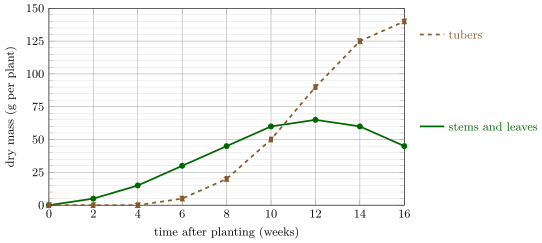
Part A. Every two weeks, a few plants are pulled up and the dry mass of the aerial stems and leaves, then that of the new tubers, is measured.
Part B. In the eighth week, on a few plants, the living cells of a short ring at the base of each aerial stem are killed with a jet of steam, without cutting the stem. In the sixteenth week, the leaves of these plants have stayed green, but the dry mass of their tubers is only per plant.
Part C. A drop of iodine solution placed on a slice of tuber gives a blue-black color. The elaborated sap taken from the stem contains sucrose, but no starch.
Part D. Harvested tubers are kept in darkness. The following spring, their “eyes” give stems several centimeters long, while the tubers shrivel and become soft.
- Describe how the dry mass of the stems and leaves changes over the sixteen weeks.
- State from which week the tubers form, then read their dry mass in the sixteenth week.
- A tuber lives underground and has no chlorophyll. Specify the origin of its organic matter.
- Compare the mass of the tubers of the steam-treated plants (part B) with that of the untreated plants, then conclude.
- Explain why the leaves of the treated plants stayed green.
- Name the storage substance of the tuber (part C), then explain how it forms there.
- Suggest an explanation for the decrease in the mass of the stems and leaves after the twelfth week.
- Explain the observations of part D.
- Write a short summary that traces what happens to the organic matter made by a potato leaf.
Solution
- The dry mass of the stems and leaves increases during the first twelve weeks: it goes from 0 to per plant. It then decreases and is only in the sixteenth week.
- The tubers start to form around the sixth week (): their mass is zero up to the fourth week. Their dry mass then increases sharply and reaches per plant in the sixteenth week.
- The tuber, with no chlorophyll and in darkness, does not carry out photosynthesis. Its organic matter comes from the leaves, which make it in the light; it is brought to it by the elaborated sap.
- In the sixteenth week, the tubers of the treated plants weigh only , versus for the untreated plants. Yet they already weighed in the eighth week, at the time of the treatment: they have hardly grown since. The organic matter of the leaves therefore no longer reaches the tubers when the living cells of the stem are killed. It moves down from the leaves to the tubers through a living tissue: the phloem.
- Crude sap rises in the xylem vessels, made of cells that are already dead: the jet of steam does not prevent them from working. The leaves still receive water and mineral ions, and stay green.
- The blue-black color with iodine solution reveals starch: it is the storage substance of the tuber. Elaborated sap brings no starch, but sucrose. It is the cells of the tuber that convert the sucrose received into starch on the spot, and accumulate it.
- After the twelfth week, the leaves age and turn yellow: they no longer make as much organic matter. Part of the matter of the stems and leaves is even exported to the tubers, which keep growing while the aerial parts become lighter.
- In spring, the buds of the tuber, the “eyes”, develop into stems. In darkness, these stems do not carry out photosynthesis: all the matter needed for their growth and their respiration comes from the starch of the tuber, converted into soluble sugars and transported toward the young stems. The tuber empties of its reserves: it shrivels and becomes soft.
- In the light, the chlorophyllic cells of the leaf make carbohydrates by photosynthesis. Part of them is used on the spot: it is used for the growth of the leaf and for the respiration of its cells. The rest is converted into sucrose and exported by the elaborated sap, which circulates in the sieve tubes of the phloem. This sap supplies the growing organs, such as the young leaves and the roots, where organic matter is incorporated into the new cells or broken down by respiration. Above all, it supplies the tubers, where sucrose is converted into starch and stored. The following spring, this starch will feed the new stems.
What the exercise establishes: follow organic matter from the leaf to the storage organ, then from the reserve to the new plant.
Similar exercises
- Two branches and a ring of bark solved
- Tracking labeled carbon solved
- Sieve tube and vessel solved
- Tests on four storage organs solved
- Germinating wheat grains solved
The course of the chapter · All the exercises of the chapter