Life Sciences (Grade 10, Lebanon) · Chapter 3 · Tutorial exercise
Sieve tube and vessel
What happens to the products of photosynthesis · B. The phloem and what happens to the substances · level 2
Statement
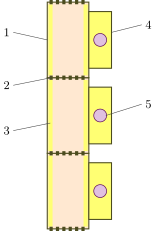
The diagram represents a fragment of phloem, based on the observation of a longitudinal section of a stem under the microscope.
On a potted plant, a jet of scalding steam is directed at a short portion of the stem: the living cells of this portion are killed, but the stem stays whole. In the following days, the leaves located above stay firm; on the other hand, organic matter accumulates above the heated portion and no longer reaches the roots.
- Give the label corresponding to each of the numbers 1 to 5.
- Name the liquid that circulates in structure 1 and name its two main organic constituents.
- Explain how this liquid passes from one cell of the row to the next.
- Find two differences between structure 1 and a xylem vessel.
- State what the steam-jet experiment shows about the circulation of the crude sap.
- State what this experiment shows about the circulation of the elaborated sap.
- Relate these two results to the state, living or dead, of the conducting cells of each tissue.
Solution
- The labels are: 1, a sieve tube (one cell of the row); 2, a sieve plate, a cross wall pierced with pores; 3, the thin cytoplasm of the sieve tube; 4, a companion cell; 5, the nucleus of the companion cell.
- Elaborated sap circulates in the sieve tube. Its two main organic constituents are sucrose and amino acids.
- The cross walls that separate two cells of the sieve tube are pierced with pores: these are the sieve plates. Elaborated sap passes from one cell to the next by crossing these pores.
- The sieve tube is made of living cells, which keep a cytoplasm, whereas the vessel is made of dead, empty cells. The cross walls of the sieve tube are kept and pierced with pores, whereas those of the vessel have disappeared. It can be added that the wall of the sieve tube is thin and has no lignin, whereas that of the vessel is thickened with lignin.
- The leaves located above the heated portion stay firm: they still receive water. Crude sap therefore keeps rising through a portion of stem whose cells have been killed.
- Organic matter accumulates above the heated portion and no longer reaches the roots: elaborated sap does not pass through a portion of stem whose cells have been killed.
- The xylem vessels are already dead cells: heat changes nothing in how they work, they remain open tubes in which crude sap is pulled up. The sieve tubes of the phloem, on the contrary, are living cells, helped by the companion cells: once killed, they no longer conduct elaborated sap. Conduction by the phloem requires living cells.
What the exercise establishes: label the phloem and contrast the living sieve tube with the dead vessel.
Similar exercises
- Two branches and a ring of bark solved
- Tracking labeled carbon solved
- Tests on four storage organs solved
- Germinating wheat grains solved
- A potato field in the Bekaa solved
The course of the chapter · All the exercises of the chapter