Life Sciences (Grade 10, Lebanon) · Chapter 3 · Tutorial exercise
The aphid's meal
What happens to the products of photosynthesis · A. Elaborated sap · level 1 (application)
Statement
An aphid settled on a young broad bean stem pushes its stylet into the stem and stays still for hours. The diagram shows a longitudinal section of the stem passing through the stylet.
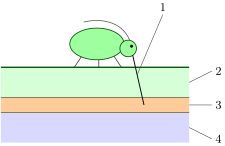
The stylet of a feeding aphid is cut: a liquid L beads at the end of the stump left in the stem, and keeps flowing for several hours. It is analyzed, along with the liquid contained in tissue 4.
| Dissolved substances (g per liter) | Liquid L | Liquid of tissue 4 |
|---|---|---|
| Sucrose | 160 | 0 |
| Amino acids | 12 | traces |
| Mineral ions | 3 | 1 |
- Given that tissue 2 is the cortex, name element 1 and tissues 3 and 4.
- State the tissue in which the tip of the stylet stops.
- Compare the composition of liquid L with that of the liquid of tissue 4.
- Name each of these two liquids.
- Specify the origin of the sucrose contained in liquid L.
- Liquid L flows out on its own through the cut stylet, without the aphid sucking it. Say what this observation teaches about this liquid.
- Explain why a large colony of aphids weakens the plant.
Solution
- Element 1 is the aphid's stylet. Tissue 3, located under the cortex, is the phloem; tissue 4, deeper, is the xylem.
- The tip of the stylet stops in the phloem: it is in this tissue that the aphid takes its food.
- Liquid L is rich in organic matter: it contains of sucrose and of amino acids per liter. The liquid of tissue 4 contains none, or only traces; it contains little more than water and a few mineral ions. Liquid L is a concentrated solution, that of tissue 4 a very dilute solution.
- Liquid L, which circulates in the phloem, is the elaborated sap. The liquid of tissue 4, which circulates in the xylem, is the crude sap.
- Sucrose is an organic matter. It comes from the carbohydrates made by photosynthesis in the chlorophyllic cells of the leaves; these carbohydrates are converted into sucrose, a soluble sugar, which leaves the leaf through the phloem.
- Since the liquid comes out on its own through the cut stylet, it is not sucked: it is pushed out of the phloem. Elaborated sap is therefore under pressure in the tubes of the phloem.
- Each aphid diverts part of the elaborated sap for its own benefit. When the aphids are very numerous, a large amount of sucrose and amino acids no longer reaches the organs of the plant that need them: buds, young leaves, flowers, fruits, roots. Their growth slows down and the plant weakens.
What the exercise establishes: the composition of the elaborated sap, contrasted with that of the crude sap, and the tissue in which it circulates.
Similar exercises
- Two branches and a ring of bark solved
- Tracking labeled carbon solved
- Sieve tube and vessel solved
- Tests on four storage organs solved
- Germinating wheat grains solved
The course of the chapter · All the exercises of the chapter