Life Sciences (Grade 10, Lebanon) · Chapter 5 · Direct application of the course
Cross circulation
Hormonal communication · level 3 (hard)
Statement
To confirm the existence of secretin, a cross circulation is set up between two anesthetized dogs, A and B: tubes link their blood vessels, so that the blood of each constantly flows through the body of the other. No nerve links the two animals. Hydrochloric acid is introduced into the intestine of dog A only, and the pancreatic juice of both dogs is collected.
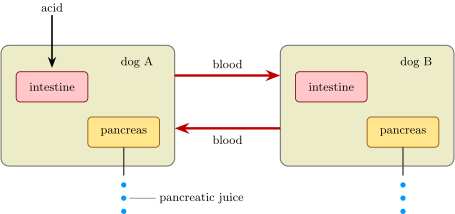
{
| Pancreatic juice (drops per minute) | Dog A | Dog B |
|---|---|---|
| before the acid is introduced | 2 | 2 |
| a few minutes later | 18 | 15 |
In a second series of trials, increasing doses of purified secretin are injected directly into the blood of a dog.
{
| Dose of secretin injected (units) | 0 | 1 | 2 | 4 |
|---|---|---|---|---|
| Pancreatic juice (drops per minute) | 2 | 8 | 14 | 22 |
- Describe the response of the pancreas of dog A.
- Describe the response of the pancreas of dog B, although its intestine received no acid.
- State the only route by which dog A could have acted on the pancreas of dog B.
- Explain all these results, specifying the organ that emits the message, the nature of this message and the organ that receives it.
- Use the second series of trials to identify a characteristic of the hormonal message.
- In dog B, the muscles and the salivary glands receive the same blood as the pancreas, and do not react. Explain.
Solution
- In dog A, the secretion of the pancreas goes from 2 to 18 drops per minute after the acid is introduced into the intestine: it is multiplied by nine.
- In dog B, the secretion goes from 2 to 15 drops per minute: it increases almost as much as in dog A, although the intestine of dog B did not receive any acid.
- No nerve links the two dogs: they communicate only through the blood, which passes from one to the other. It is therefore the blood coming from dog A that brought to the pancreas of dog B the information that acid was present.
- On contact with the acid, the mucosa of the intestine of dog A releases a hormone, secretin, into the blood. The blood carries it throughout the body of dog A, where it reaches the pancreas, and, thanks to the cross circulation, into the body of dog B, where it also reaches the pancreas. In both cases, secretin triggers the secretion of pancreatic juice. The emitting organ is the intestine, the message is a hormone carried by the blood, the receiving organ is the pancreas.
- The secretion of the pancreas increases with the dose of secretin: 8 drops per minute for 1 unit, 14 for 2 units, 22 for 4 units. The response of the target organ is all the stronger as the quantity of hormone present in the blood is large: the hormonal message is coded by the concentration of the hormone.
- The blood brings secretin to all the organs, but only the cells that have receptors for this hormone can bind it and respond to it. The cells of the pancreas have them: they are target cells. Those of the muscles and of the salivary glands do not have them: they do not react.
Similar exercises
- The rat without a thyroid solved
- Exocrine gland or endocrine gland? solved
- Locating and labeling the thyroid solved
- The growth of young rats solved
- The testis, an endocrine gland solved
The course of the chapter · All the exercises of the chapter