Life Sciences (Grade 10, Lebanon) · Chapter 5 · Direct application of the course
Exocrine gland or endocrine gland?
Hormonal communication · level 1 (application)
Statement
Diagrams X and Y represent two glands of different types.
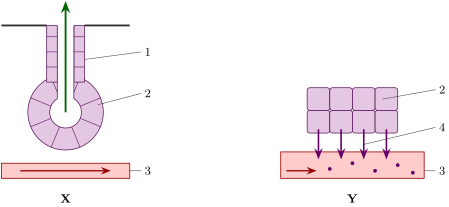
- Give the label corresponding to each of the numbers 1 to 4.
- State where gland X releases its secretion and where gland Y releases its own.
- Name the type of each of the two glands, justifying the answer.
- Sort the following glands into one or the other type: salivary gland, thyroid, sweat gland.
- The pancreas releases a digestive juice into the intestine through a duct. Specify to which type of gland it belongs for this secretion.
Solution
- The labels are: 1, the excretory duct; 2, the secretory cells; 3, a blood capillary; 4, the secretion (a hormone) passing into the blood.
- Gland X releases its secretion through its excretory duct, onto the surface of the body or into a cavity of the organism. Gland Y releases its own directly into the blood of the neighboring capillary.
- Gland X has an excretory duct: it is an exocrine gland. Gland Y has no excretory duct and its secretory cells release their secretion into the blood: it is an endocrine gland, and its secretion is a hormone.
- The salivary gland, which releases saliva into the mouth through a duct, and the sweat gland, which releases sweat onto the surface of the skin through a duct, are exocrine glands. The thyroid, which releases thyroxine into the blood, is an endocrine gland.
- For the secretion of pancreatic juice, discharged through a duct into the intestine, the pancreas is an exocrine gland.
Similar exercises
- The rat without a thyroid solved
- Locating and labeling the thyroid solved
- The growth of young rats solved
- The testis, an endocrine gland solved
- Cross circulation solved
The course of the chapter · All the exercises of the chapter