Life Sciences (Grade 10, Lebanon) · Chapter 5 · Tutorial exercise
Labeling a section of thyroid
Hormonal communication · B. The thyroid and the hormonal message · level 2
Statement
The diagram below was made from the observation of a section of thyroid under the light microscope.
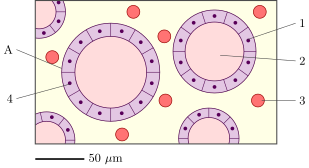
- Give the label corresponding to each of the numbers 1 to 4, then name structure A as a whole.
- State what part 2 contains.
- Find, on the diagram, two characteristics that show that the thyroid is an endocrine gland.
- Specify the path followed by the hormone from cells 1 to the organs of the body.
- Structure A is twice as wide as the scale bar. Calculate its real diameter.
Solution
- The labels are: 1, a secretory cell of the wall of the follicle; 2, the colloid; 3, a blood capillary; 4, the nucleus of a cell. Structure A is a thyroid follicle.
- The colloid contains the thyroid hormones made by the cells of the wall of the follicle: it forms their store.
- First characteristic: many blood capillaries are placed between the follicles, in contact with the secretory cells; the gland is very richly supplied with blood. Second characteristic: no excretory duct can be seen leaving the follicles. A gland formed of secretory cells, richly supplied with blood and without an excretory duct is an endocrine gland.
- The hormone leaves the secretory cells and passes into the blood of the neighboring capillaries. The blood carries it away through the veins of the thyroid, then distributes it to all the organs of the body.
- The scale bar represents . Follicle A is twice as wide: its real diameter is , that is, one tenth of a millimeter.
What the exercise establishes: recognize an endocrine gland by its structure: secretory cells, many capillaries, no excretory duct.
Similar exercises
- The intestinal loop deprived of its nerves solved
- Three injections for one active substance solved
- Tadpoles that do not become frogs solved
- Radioactive iodine and the thyroid solved
- The rat without a thyroid solved
The course of the chapter · All the exercises of the chapter