Life Sciences (Grade 10, Lebanon) · Chapter 5 · Tutorial exercise
Radioactive iodine and the thyroid
Hormonal communication · B. The thyroid and the hormonal message · level 2
Statement
A very small quantity of radioactive iodine is injected into a rat, then the radioactivity of its thyroid and that of a leg muscle, whose mass is about one hundred times greater than that of the thyroid, are measured at different times. The graph presents the experimental results. It is also found that, the day after the injection, the blood of the animal contains radioactive thyroxine.
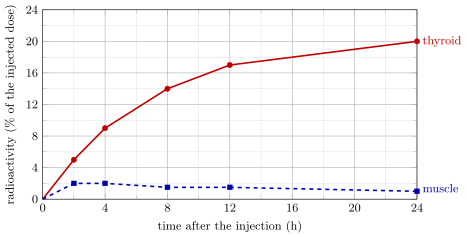
- Read the radioactivity of the thyroid 4 hours, then 24 hours after the injection.
- Describe how the radioactivity of the thyroid changes.
- Compare the radioactivity of the thyroid and that of the muscle at 24 hours.
- Deduce from this comparison a property of the cells of the thyroid.
- Explain the presence of radioactive thyroxine in the blood the day after the injection.
- Explain why a diet too poor in iodine disturbs the functioning of the thyroid.
Solution
- The graph reads: 9% of the injected dose at 4 hours, and 20% at 24 hours.
- The radioactivity of the thyroid increases quickly during the first hours (from 0 to 14% in 8 hours), then more and more slowly; it reaches 20% of the injected dose after 24 hours.
- At 24 hours, the thyroid contains 20% of the injected iodine, whereas the muscle contains only 1%. The thyroid, although one hundred times smaller than this muscle, holds twenty times more radioactive iodine than it.
- The cells of the thyroid take up the iodine brought by the blood and concentrate it; the cells of the muscle do not.
- The iodine taken up by the thyroid is used to make thyroxine, whose molecule contains iodine. Thyroxine made with radioactive iodine is itself radioactive. It is then released into the blood, where it is found the next day: it is indeed the thyroid that secretes thyroxine into the blood.
- Without iodine, the thyroid cannot make thyroxine, since iodine is part of the composition of this hormone. If the diet provides too little of it, the quantity of thyroxine secreted becomes insufficient: the activity of the cells slows down, and the gland, which works in vain, increases in volume and forms a goiter.
What the exercise establishes: follow a labeled substance, from its entry into the gland to the release of the hormone into the blood.
Similar exercises
- The intestinal loop deprived of its nerves solved
- Three injections for one active substance solved
- Labeling a section of thyroid solved
- Tadpoles that do not become frogs solved
- The rat without a thyroid solved
The course of the chapter · All the exercises of the chapter