Life Sciences (Grade 10, Lebanon) · Chapter 5 · Direct application of the course
The growth of young rats
Hormonal communication · level 2
Statement
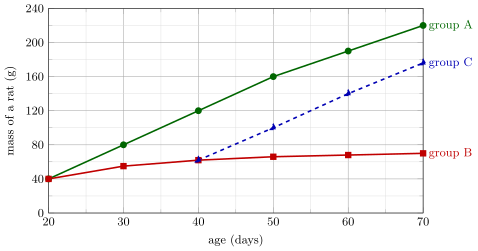
The mass of three groups of young rats from the same litter is followed. The rats of group A are controls. Those of groups B and C had their thyroid removed at the age of 20 days; those of group C also receive, from the age of 40 days, a daily injection of thyroxine. The graph presents the mean mass of a rat of each group (experimental results).
- Read the mass of a rat of each group at the age of 70 days.
- Calculate the mass gain of a rat of group A, then of a rat of group B, between 20 and 70 days.
- Compare the growth of groups A and B, then conclude.
- Calculate the mean daily mass gain of a rat of group C between 40 and 70 days, and compare it with that of a rat of group A over the same period.
- Deduce from group C how the thyroid acts on growth.
- Explain why the injections of thyroxine must be repeated every day.
Solution
- At 70 days, a rat of group A weighs 220 g, a rat of group B weighs 70 g and a rat of group C weighs 176 g.
- Group A: g gained in 50 days. Group B: g gained in 50 days.
- The control rats grow steadily and gain 180 g. The rats deprived of their thyroid still grow a little during the first days, then their mass hardly changes any more: they gain only 30 g, six times less. The thyroid is therefore essential for the growth of the young rat.
- Group C, between 40 and 70 days: g in 30 days, that is
Group A, over the same period: g in 30 days, that is about g per day. As soon as they receive thyroxine, the rats without a thyroid grow as fast as the controls, and even a little faster: they make up part of their delay.
- Thyroxine alone restores the growth of rats that no longer have a thyroid. The thyroid therefore acts on growth through this chemical substance, which it secretes into the blood: thyroxine is a hormone.
- The injected thyroxine is gradually destroyed or eliminated by the organism: its concentration in the blood drops within a few days. For the cells to receive it permanently, as in an animal whose thyroid secretes continuously, the injection must be repeated regularly.
Similar exercises
- The rat without a thyroid solved
- Exocrine gland or endocrine gland? solved
- Locating and labeling the thyroid solved
- The testis, an endocrine gland solved
- Cross circulation solved
The course of the chapter · All the exercises of the chapter