Life Sciences (Grade 10, Lebanon) · Chapter 5 · Tutorial exercise
The rat without a thyroid
Hormonal communication · B. The thyroid and the hormonal message · level 3 (hard)
Statement
The role of the thyroid in the adult rat is studied.
Part A. Two weeks after the operation, rats whose thyroid has been removed are compared with control rats that underwent the same operation, but without removal of the gland.
| Measurement at rest | Control rats | Rats without a thyroid |
|---|---|---|
| Body temperature (°C) | 37.5 | 35.5 |
| Heart rate (beats per minute) | 380 | 290 |
| Oxygen consumed (% of the control value) | 100 | 62 |
Part B. Rats without a thyroid receive a graft of a fragment of thyroid under the skin of the belly. Within a few days, blood vessels develop around the graft. Two weeks later, their temperature, their heart rate and their oxygen consumption are those of the controls.
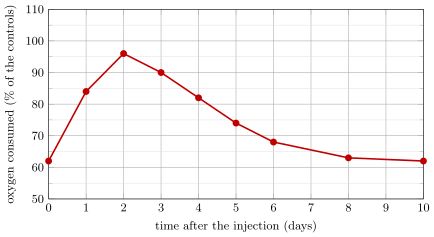
Part C. A rat without a thyroid receives a single injection of thyroxine (a quantity on the order of a few micrograms). Its oxygen consumption is measured during the following ten days.
- Compare the rats without a thyroid with the control rats (Part A), then conclude on the role of the thyroid.
- Justify the operation carried out on the control rats.
- Show, using Part B, that the thyroid does not act through nerves.
- Read, in Part C, the oxygen consumption at the time of the injection, its maximum value and the day on which it is reached.
- Describe how the oxygen consumption changes after the second day, then explain it.
- Find, in the text of Part C, the information that shows that a hormone acts at a very low dose.
- State how one should proceed to maintain the oxygen consumption of a rat without a thyroid at 100% over the long term.
- Write a summary of about ten lines that presents the thyroid as an endocrine gland and that states the characteristics of the hormonal message revealed in this problem.
Solution
- In the rats without a thyroid, the body temperature is lower (35.5 °C compared with 37.5 °C), the heart beats more slowly (290 beats per minute compared with 380) and the oxygen consumption is only 62% of that of the controls. The whole organism functions in slow motion: the thyroid stimulates the activity of all the cells.
- The control rats undergo the same operation, without removal, so that the two groups differ only by the presence of the thyroid. It is thus certain that the disorders observed are due to the absence of the gland, and not to the anesthesia or the wound.
- The grafted fragment is placed under the skin of the belly, far from the neck: it has lost all its nervous links. It is linked to the rest of the body only by the blood vessels that developed around it. Yet it is enough to restore normal functioning: the thyroid therefore acts through the blood, by releasing a substance into it.
- At the time of the injection, the oxygen consumption is 62% of that of the controls. It reaches a maximum of 96% on the second day.
- After the second day, the oxygen consumption decreases steadily: 90% on the third day, 74% on the fifth, and it returns to its starting value, 62%, around the tenth day. The injected thyroxine is gradually destroyed or eliminated by the organism: its concentration in the blood drops, and the activity of the cells drops with it. Since the rat no longer has a thyroid, nothing replaces the hormone that disappears.
- The quantity injected is on the order of a few micrograms, that is, a few millionths of a gram. Such a tiny quantity is enough to increase the oxygen consumption of the animal by more than half in two days (from 62% to 96% of the control value, that is, about 1.5 times more): a hormone acts at a very low dose.
- The injections of thyroxine would have to be repeated regularly, for example every day, so as to keep the concentration of the hormone in the blood constant; this is what the thyroid normally does by secreting continuously. A thyroid graft would give the same result.
- The thyroid is an endocrine gland: its secretory cells make a hormone, thyroxine, and release it directly into the blood of the many capillaries that surround them, without going through an excretory duct. Its removal slows down the whole organism, while a graft without nerves or an injection of thyroxine restores normal functioning: the gland therefore acts by the blood route and through a chemical substance. The hormonal message has several characteristics. It is chemical and carried by the blood throughout the body. It is received only by the target cells, which have receptors for the hormone; for thyroxine, these cells are very numerous. It acts at a very low dose, and its effect depends on the concentration of the hormone in the blood. Finally, it has a limited duration, because the hormone is destroyed or eliminated: the gland must therefore secrete permanently to maintain it.
What the exercise establishes: bring together in a single line of reasoning the experimental method, the definition of an endocrine gland and the characteristics of the hormonal message.
Similar exercises
- The intestinal loop deprived of its nerves solved
- Three injections for one active substance solved
- Labeling a section of thyroid solved
- Tadpoles that do not become frogs solved
- Radioactive iodine and the thyroid solved
The course of the chapter · All the exercises of the chapter