Life Sciences (Grade 10, Lebanon) · Chapter 5 · Tutorial exercise
Three injections for one active substance
Hormonal communication · A. The discovery of chemical communication · level 2
Statement
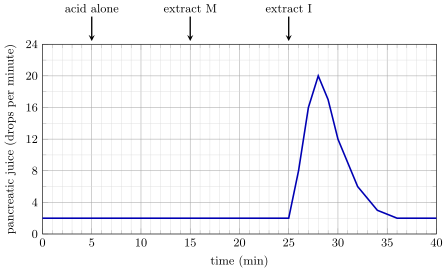
To find out which substance passes into the blood, two extracts are prepared. Extract I is obtained by grinding intestinal mucosa with a little acid, then filtering. Extract M is obtained in the same way from muscle. In an anesthetized dog, acid alone, extract M, then extract I are injected successively into a vein, while counting the drops of pancreatic juice. The graph presents results of the kind obtained.
- Read the number of drops per minute before any injection.
- Describe the effect of the injection of acid alone, then conclude.
- Describe the effect of the injection of extract I: maximum value reached, delay, return to the starting value.
- Compare the effects of extracts M and I, then conclude on the origin of the active substance.
- Name this substance and the organ on which it acts.
- Explain why the secretion of the pancreas returns to its starting value a few minutes after the injection of extract I.
Solution
- Before any injection, the pancreas gives 2 drops of juice per minute.
- After the injection of acid alone, at 5 min, the secretion remains at 2 drops per minute. The acid, carried by the blood, has no effect on the pancreas: it is not the acid that directly stimulates this gland.
- After the injection of extract I, at 25 min, the secretion increases very quickly: it reaches a maximum of 20 drops per minute at 28 min, that is, three minutes after the injection and ten times the starting value. It then decreases and returns to its starting value, 2 drops per minute, at 36 min.
- Extract M, prepared from muscle, does not change the secretion, whereas extract I, prepared in the same way from intestinal mucosa, multiplies it by ten. The active substance is therefore made by the mucosa of the intestine, and not by just any organ.
- This substance is secretin. It acts on the pancreas, whose secretion of juice it triggers.
- The injected secretin acts only as long as it is present in the blood. Yet a hormone is quickly destroyed or eliminated by the organism: its concentration in the blood decreases, and the secretion of the pancreas decreases with it. Since nothing renews the secretin after the injection, the effect stops within about ten minutes.
What the exercise establishes: read a recording marked with injections, and use a control extract to attribute a hormone to the organ that makes it.
Similar exercises
- The rooster's comb and the testis solved
- The intestinal loop deprived of its nerves solved
- Labeling a section of thyroid solved
- Tadpoles that do not become frogs solved
- Radioactive iodine and the thyroid solved
The course of the chapter · All the exercises of the chapter