Life Sciences (Grade 10, Lebanon) · Chapter 6 · Tutorial exercise
Producing more, but at what price?
Productivity of a crop and environmental factors · B. Limiting factor · level 3 (hard)
Statement
On the coast, a tomato grower is hesitating between several ways of growing. The grower gathers the results of three trials carried out with the same variety.
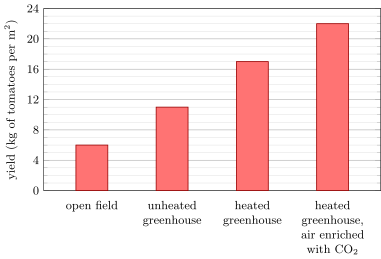
Part A. Yield obtained according to the growing method.
Part B. In the unheated greenhouse, two irrigation techniques are compared.
| Irrigation technique | Water supplied during the season (liters per m²) | Yield (kg per m²) |
|---|---|---|
| furrow | 800 | 10 |
| drip | 440 | 11 |
Part C. Two observations made in the greenhouse. In winter, heating is the grower's largest expense. In summer, at noon, the temperature of the closed greenhouse reaches , whereas the photosynthesis of the tomato is maximum at around and almost zero above .
- Read the yield obtained for each of the four growing methods of Part A.
- Calculate the yield gain due to the unheated greenhouse, compared with the open field, then give an environmental factor that this greenhouse improves.
- Calculate the yield gain due to heating, then that due to enriching the air with carbon dioxide.
- Explain these successive gains using the notion of limiting factor.
- Calculate, for each irrigation technique of Part B, the mass of tomatoes obtained with 1 000 liters of water.
- Explain why drip irrigation consumes less water than furrow irrigation.
- State the consequence, for the harvest, of the temperature recorded in summer in the closed greenhouse, then propose an action.
- Identify from Part C two limits of greenhouse growing.
- Write a short summary that explains to the grower how a greenhouse makes it possible to increase production, and under what conditions.
Solution
- The graph reads: 6 kg per square meter in the open field, 11 kg in the unheated greenhouse, 17 kg in the heated greenhouse and 22 kg in the heated greenhouse whose air is enriched with carbon dioxide.
- From 6 to 11 kg per square meter, the gain is per square meter. The transparent covering of the greenhouse lets light in and holds the heat: the greenhouse improves the temperature.
- Heating brings the yield from 11 to 17 kg per square meter: the gain is per square meter. Carbon dioxide enrichment brings it from 17 to 22 kg per square meter: the gain is per square meter.
- Production is set by the most insufficient factor. In the unheated greenhouse, the temperature remains too low during the cold season: it is limiting, and heating increases production. Once the greenhouse is heated, another factor becomes limiting: carbon dioxide, which the plants deplete in the air of the closed greenhouse. Enrichment in turn lifts this limiting factor, and production increases further.
- With furrows, 800 liters give 10 kg of tomatoes; 1 000 liters therefore give: With drip irrigation, 440 liters give 11 kg; 1 000 liters therefore give: With the same quantity of water, drip irrigation produces twice as many tomatoes.
- Drip irrigation delivers the water at the foot of each plant, where the roots are, and in small quantities at a time. In furrows, the water wets all the soil between the rows: a large part evaporates or seeps deep down without benefiting the plants.
- At , the temperature is far above the optimum temperature (): photosynthesis is almost zero, the plants make almost no more organic matter and the harvest drops. The temperature must be lowered: open the ventilation openings, shade the greenhouse.
- First limit: cost. Heating the greenhouse is a large expense, which the extra harvest must pay back. Second limit: excess. A favorable factor can become harmful if it exceeds its optimum value; this is the case of the temperature of the closed greenhouse in summer.
- A greenhouse is a shelter with a transparent covering in which environmental factors can be controlled: temperature (the covering holds the heat, heating supplements it in winter, ventilation lowers it in summer), light intensity (supplementary lamps), the carbon dioxide content of the air (enrichment), water and mineral salts (drip irrigation). Production increases each time the limiting factor is improved; improving another factor is of no use. Excesses, such as too high a temperature, must also be avoided, and it must be checked that the extra harvest pays back the expenses on equipment and energy.
What the exercise establishes: bring together in a single line of reasoning productivity, the limiting factor, actions on the environment and their limits.
Similar exercises
- Light intensity and the photosynthesis of a lettuce plant solved
- Temperature and the photosynthesis of a tomato plant solved
- Two carbon dioxide contents for a bell pepper plant solved
- Water or nitrogen for a corn field? solved
- The carbon dioxide of a closed greenhouse solved
The course of the chapter · All the exercises of the chapter