Life Sciences (Grade 10, Lebanon) · Chapter 6 · Tutorial exercise
Temperature and the photosynthesis of a tomato plant
Productivity of a crop and environmental factors · A. Productivity and photosynthesis · level 2
Statement
The photosynthetic intensity of a tomato plant is measured at different temperatures. The light intensity (30 000 lux) and the carbon dioxide content of the air (400 ppm) remain constant.
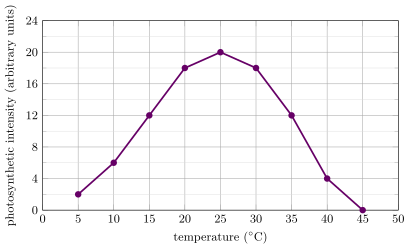
- Read the photosynthetic intensity at , at and at .
- Describe how photosynthetic intensity varies when temperature increases.
- Give the optimum temperature of photosynthesis for this plant.
- State between which temperatures photosynthetic intensity is at least equal to 18.
- A winter night has cooled a greenhouse: in the morning, it is inside. Calculate by how much photosynthetic intensity is multiplied if heating brings the temperature to .
- In midsummer, the temperature of a closed greenhouse reaches . State the consequence for photosynthesis and propose an action.
- Compare the shape of this curve with that of a curve of photosynthetic intensity as a function of light intensity.
Solution
- The graph reads: 6 at , 20 at and 4 at .
- Photosynthetic intensity increases from to , where it passes through a maximum (20). It then decreases and falls to zero at .
- The optimum temperature is that of the maximum: .
- Photosynthetic intensity is 18 at and at , and it is greater in between. It is therefore at least equal to 18 between and .
- Photosynthetic intensity goes from 6 at to 18 at : Heating multiplies photosynthetic intensity by 3.
- At , photosynthetic intensity is only 4, five times less than at the optimum temperature: production collapses. The temperature must be lowered, for example by opening the ventilation openings or by shading the greenhouse.
- As a function of light intensity, the curve rises then forms a plateau: a stronger light intensity does not lower photosynthesis. As a function of temperature, the curve rises, passes through a maximum, then falls again: too high a temperature is harmful. Temperature therefore acts both by deficiency and by excess.
What the exercise establishes: locate an optimum, and understand that a factor can do harm through excess.
Similar exercises
- The dry matter of a wheat field solved
- Light intensity and the photosynthesis of a lettuce plant solved
- Two carbon dioxide contents for a bell pepper plant solved
- Water or nitrogen for a corn field? solved
- The carbon dioxide of a closed greenhouse solved
The course of the chapter · All the exercises of the chapter