Life Sciences (Grade 10, Lebanon) · Chapter 6 · Tutorial exercise
The carbon dioxide of a closed greenhouse
Productivity of a crop and environmental factors · B. Limiting factor · level 2
Statement
A probe records the carbon dioxide content of the air of a cucumber greenhouse for twenty-four hours, on a sunny winter day. The greenhouse remains closed to keep its heat. The sun rises at about 7:00 and sets at about 17:00. The outside air contains 400 ppm of carbon dioxide.
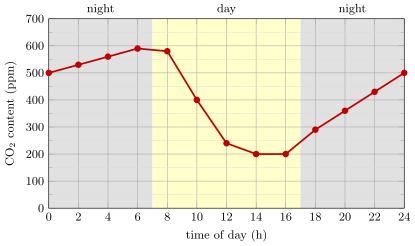
- Read the carbon dioxide content at 6:00, at 10:00 and at 14:00.
- Describe how the carbon dioxide content varies between 18:00 and 6:00, then explain it.
- Describe how the carbon dioxide content varies between 8:00 and 14:00, then explain it.
- Compare the content of the greenhouse air at 14:00 with that of the outside air.
- For the cucumber, photosynthetic intensity under strong light is about half as great at 200 ppm as at 400 ppm. Identify the limiting factor of photosynthesis in this greenhouse in the early afternoon.
- Propose two actions that would lift this limiting factor, and give one drawback of each.
- Explain why it would be useless to enrich the air of the greenhouse with carbon dioxide during the night.
Solution
- The graph reads: 590 ppm at 6:00, 400 ppm at 10:00 and 200 ppm at 14:00.
- Between 18:00 and 6:00, the carbon dioxide content increases steadily, from 290 to 590 ppm. It is night: without light, the plants do not carry out photosynthesis. They respire, like all the living beings in the greenhouse, and release carbon dioxide, which accumulates in the closed greenhouse.
- Between 8:00 and 14:00, the carbon dioxide content decreases sharply, from 580 to 200 ppm. It is daytime: the lit plants carry out photosynthesis and absorb the carbon dioxide of the air. Since the greenhouse is closed, outside air does not replace the carbon dioxide absorbed.
- At 14:00, the air of the greenhouse contains only 200 ppm of carbon dioxide, half as much as the outside air (400 ppm).
- In the early afternoon, the greenhouse is well lit and its temperature is favorable, but its air is depleted of carbon dioxide, and photosynthesis there is half as great as in ordinary air. The most insufficient factor is carbon dioxide: it is the limiting factor.
- First action: open the ventilation openings, so that outside air brings the content back toward 400 ppm; drawback: in winter, the greenhouse loses its heat. Second action: enrich the air of the greenhouse with carbon dioxide, keeping the greenhouse closed; drawback: it requires equipment and carbon dioxide, which has a cost.
- At night, there is no light, so no photosynthesis: the plants do not absorb carbon dioxide. The limiting factor is then light; supplying carbon dioxide would be of no use.
What the exercise establishes: relate a recording to the gas exchanges of the plant, and see that a closed greenhouse itself creates its limiting factor.
Similar exercises
- Light intensity and the photosynthesis of a lettuce plant solved
- Temperature and the photosynthesis of a tomato plant solved
- Two carbon dioxide contents for a bell pepper plant solved
- Water or nitrogen for a corn field? solved
- Producing more, but at what price? solved
The course of the chapter · All the exercises of the chapter