Life Sciences (Grade 10, Lebanon) · Chapter 6 · Tutorial exercise
Two carbon dioxide contents for a bell pepper plant
Productivity of a crop and environmental factors · B. Limiting factor · level 2
Statement
The photosynthetic intensity of a bell pepper plant is measured as a function of light intensity, in two airs with different carbon dioxide contents. The temperature is in both cases.
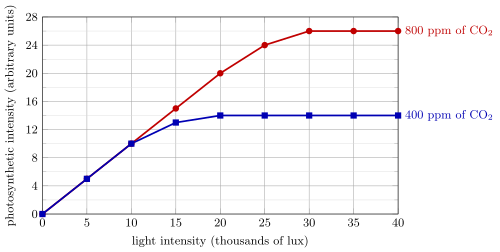
- Read the photosynthetic intensity at 10 000 lux, then at 30 000 lux, for each of the two carbon dioxide contents.
- Compare the two curves between 0 and 10 000 lux.
- Deduce the limiting factor of photosynthesis at low light intensities.
- Compare the two curves at 30 000 lux.
- Deduce the limiting factor of photosynthesis at 30 000 lux in air at 400 ppm.
- Calculate the gain in photosynthetic intensity obtained at 30 000 lux when going from 400 to 800 ppm.
- Predict the shape of the curve that would be obtained in air at 200 ppm of carbon dioxide.
Solution
- At 10 000 lux, photosynthetic intensity is 10 for both contents. At 30 000 lux, it is 14 at 400 ppm and 26 at 800 ppm.
- Between 0 and 10 000 lux, the two curves coincide: photosynthetic intensity increases with light intensity, in the same way whatever the carbon dioxide content.
- At low light intensities, photosynthesis increases when light intensity increases, and it does not change when the carbon dioxide content is doubled. The limiting factor is light intensity.
- At 30 000 lux, both curves have reached their plateau: increasing the light intensity further changes nothing. But the plateau is higher at 800 ppm (26) than at 400 ppm (14).
- At 30 000 lux and at 400 ppm, photosynthesis no longer increases with light intensity, but it increases if more carbon dioxide is supplied. The limiting factor is carbon dioxide.
- At 30 000 lux, photosynthetic intensity goes from 14 to 26: the gain is units. Photosynthesis is almost doubled.
- At low light intensities, light is limiting whatever the carbon dioxide content: the curve at 200 ppm would begin like the other two. But carbon dioxide would become limiting sooner: the curve would separate from the others at a lower light intensity and would form a plateau lower than 14.
What the exercise establishes: read a family of curves — common part: the factor on the x-axis is limiting; shifted plateaus: it is the other factor.
Similar exercises
- Light intensity and the photosynthesis of a lettuce plant solved
- Temperature and the photosynthesis of a tomato plant solved
- Water or nitrogen for a corn field? solved
- The carbon dioxide of a closed greenhouse solved
- Producing more, but at what price? solved
The course of the chapter · All the exercises of the chapter