Life Sciences (Grade 10, Lebanon) · Chapter 6 · Direct application of the course
What dose of fertilizer for a corn field?
Productivity of a crop and environmental factors · level 2
Statement
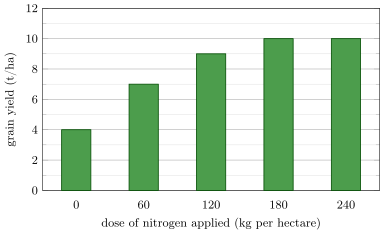
Five identical corn plots, irrigated in the same way, receive different doses of a nitrogen fertilizer. The graph gives the grain yield of each plot.
- Read the yield of each of the five plots.
- Explain why the plot without fertilizer still produces grain.
- Calculate the yield gain obtained for each new increment of 60 kg of nitrogen.
- Describe how this gain changes as the dose increases.
- State, justifying the answer, for which doses nitrogen is the limiting factor of the yield.
- Propose the dose to recommend to the farmer, knowing that fertilizer is expensive.
- State what happens to the nitrogen applied in excess.
Solution
- The yields are 4 t/ha without fertilizer, 7 t/ha for 60 kg of nitrogen, 9 t/ha for 120 kg, 10 t/ha for 180 kg and 10 t/ha for 240 kg.
- The soil naturally contains mineral salts, including nitrates: the corn finds a little nitrogen there, which allows it to produce 4 t of grain per hectare without any supply.
- From 0 to 60 kg, the gain is t/ha; from 60 to 120 kg, it is t/ha; from 120 to 180 kg, it is t/ha; from 180 to 240 kg, it is t/ha.
- The gain decreases with each new increment (3, then 2, then 1 t/ha) and it ends up at zero: the last 60 kilograms of nitrogen bring nothing.
- From 0 to 180 kg per hectare, the yield increases when the dose of nitrogen increases: nitrogen is the limiting factor. Beyond 180 kg, the yield remains at 10 t/ha: nitrogen is no longer limiting; another factor (water, another mineral salt, light intensity…) sets the yield.
- A dose of 240 kg is useless: it costs more than 180 kg and gives the same harvest. Between 120 and 180 kg, the gain is only 1 t/ha: the farmer will choose a dose between 120 and 180 kg per hectare, depending on whether or not the extra tonne of grain pays back the price of the 60 kg of nitrogen.
- The nitrogen that the crop does not use remains in the soil in the form of nitrates. Rainwater or irrigation water carries it to rivers and groundwater, which it pollutes. An excess of fertilizer is therefore both a waste and a source of pollution.
Similar exercises
- Producing more, but at what price? solved
- Productivity and yield of a potato field solved
- Carbon dioxide and the photosynthesis of a wheat leaf solved
- Light intensity, temperature and limiting factor solved
- Heating a greenhouse, enriching it with carbon dioxide, or both? solved
The course of the chapter · All the exercises of the chapter