Life Sciences (Grade 10, Lebanon) · Chapter 7 · Direct application of the course
A pond over the months
Pollution of fresh water · level 2
Statement
A pond receives the runoff from fields fertilized in spring. From April to October, the quantity of microscopic algae at the surface (in arbitrary units) and the dissolved oxygen content of the bottom water (in mg per liter) are measured there every month.
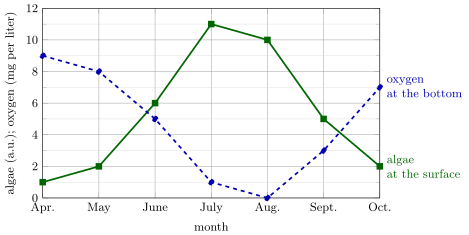
- Read the quantity of algae and the oxygen content at the bottom in April, then in July.
- Describe how the quantity of algae changes from April to July and suggest an explanation.
- Describe how the oxygen at the bottom changes over the same period.
- Explain the link between these two changes.
- State the month when the fish at the bottom are most threatened, justifying the answer.
- Name the phenomenon this pond is suffering from.
- Explain why the oxygen at the bottom rises again in autumn.
Solution
- In April, the quantity of algae is 1 unit and the bottom contains 9 mg of oxygen per liter. In July, the quantity of algae is 11 units and the bottom contains only 1 mg of oxygen per liter.
- From April to July, the quantity of algae is multiplied by 11. The runoff has brought to the pond the nitrates and phosphates of the fertilizers spread in spring; these mineral salts, together with the light and warmth of summer, make the algae proliferate.
- Over the same period, the oxygen at the bottom decreases sharply: it goes from 9 to 1 mg per liter.
- Algae live only a few days: the more numerous they are, the more of them die. The dead algae fall to the bottom, where bacteria decompose them. These bacteria respire and consume the oxygen of the deep water, which the light, stopped by the green water, cannot renew through photosynthesis.
- The fish at the bottom are most threatened in August: the dissolved oxygen there is zero, they can no longer breathe.
- Excess of mineral salts, proliferation of algae, then lack of oxygen: the pond is undergoing eutrophication.
- In autumn, the quantity of algae decreases (5 then 2 units): there is less organic matter to decompose, so less oxygen consumed by the bacteria. The oxygen brought by the air and by the mixing of the water can once again accumulate at the bottom.
Similar exercises
- The green lake and the well solved
- Recognizing the types of pollution solved
- Recognizing four indicator invertebrates solved
- The hot water of a power plant solved
- Fertilizer dose and leached nitrates solved
The course of the chapter · All the exercises of the chapter