Life Sciences (Grade 10, Lebanon) · Chapter 7 · Tutorial exercise
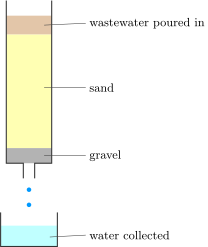
A sand column to imitate the soil
Pollution of fresh water · B. Eutrophication and groundwater · level 2
Statement
To study what happens to water that seeps into the ground, the same wastewater is poured at the top of three columns containing different thicknesses of sand, then the water collected at the base of each one is analyzed.
| Measurement | Water poured in | After 20 cm of sand | After 50 cm of sand | After 100 cm of sand |
|---|---|---|---|---|
| Suspended matter (mg per liter) | 150 | 40 | 10 | 2 |
| Bacteria of fecal origin (per 100 mL) | 40 000 | 6 000 | 500 | 10 |
| Nitrates (mg per liter) | 60 | 60 | 59 | 59 |
- Describe the effect of passing through the sand on the suspended matter.
- Describe the effect of the thickness of sand on the number of bacteria.
- Explain how the sand rids the water of its suspended matter and its bacteria.
- Name the phenomenon thus revealed.
- Describe the effect of passing through the sand on the nitrates, then explain it.
- One aquifer lies only 30 cm below the surface of the ground; another at 20 m. State which is better protected from bacteria, justifying the answer.
- State whether the deep aquifer is protected from nitrates, justifying the answer.
Solution
- The more sand the water passes through, the less suspended matter it contains: 150 mg per liter in the water poured in, 40 after 20 cm of sand, 10 after 50 cm and only 2 after 100 cm.
- The number of bacteria decreases sharply as the thickness of sand increases: from 40 000 per 100 mL in the water poured in, it falls to 6 000 after 20 cm, to 500 after 50 cm and to 10 after 100 cm.
- The sand acts as a filter: the particles and many bacteria stay caught between the grains while the water flows. In addition, pathogenic bacteria, held outside the organism that sheltered them, end up dying.
- The water purifies itself by passing through the sand: this is the self-purification of infiltration water.
- The nitrate content hardly changes: 60 mg per liter in the water poured in, 59 after 100 cm of sand. Nitrates are dissolved in the water and are not retained by the grains: they pass through the filter with it.
- The aquifer located at 20 m is better protected from bacteria: the infiltration water passes through a great thickness of rock before reaching it, and self-purification is all the more complete as the layer passed through is thick. After only 30 cm, thousands of bacteria per 100 mL still remain.
- The deep aquifer is not protected from nitrates: since the soil does not retain them, they end up reaching it, whatever the thickness passed through. It just takes them longer.
What the exercise establishes: the self-purification of infiltration water, its link with the thickness passed through, and its powerlessness against nitrates.
Similar exercises
- The BOD of three waters solved
- A river downstream of a dairy solved
- A biotic index at three sites solved
- Twenty-four hours in a green pond solved
- The green lake and the well solved
The course of the chapter · All the exercises of the chapter