Life Sciences (Grade 10, Lebanon) · Chapter 7 · Tutorial exercise
The green lake and the well
Pollution of fresh water · B. Eutrophication and groundwater · level 3 (hard)
Statement
A dam lake, 20 m deep, is fed by a river that crosses a plain of irrigated crops and several villages without a wastewater treatment plant. Every summer, its water turns green.
Part A. The mass of phosphorus that reaches the lake each year has been estimated, according to its origin.
| Origin | Phosphorus (tonnes per year) |
|---|---|
| Wastewater of the villages | 30 |
| Fertilizers washed away by runoff | 15 |
| Livestock waste | 3 |
| Natural inputs (rocks, forests) | 2 |
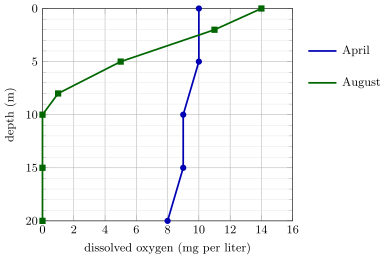
Part B. The dissolved oxygen is measured at different depths, at noon, in April then in August.
Part C. 300 m from the lake, a village draws its water from a well that reaches an aquifer lying under 25 m of sand. Twenty years ago, this water contained 18 mg of nitrates per liter; today it contains 58 mg per liter. No bacteria of fecal origin have ever been found in it.
- Calculate the total mass of phosphorus received each year by the lake, then the percentage due to human activities.
- Identify the main source of phosphorus and explain where this phosphorus comes from.
- Describe the distribution of dissolved oxygen in April.
- Describe the distribution of dissolved oxygen in August.
- Explain the high oxygen content measured at the surface in August.
- Explain the absence of oxygen at the bottom of the lake in August.
- It is assumed that the fish of the lake need at least 5 mg of oxygen per liter. Mark out the layer of water where they can live in August.
- Name the phenomenon the lake is suffering from.
- Explain why the water of the well contains no bacteria although it is becoming richer in nitrates.
- State whether the water of the well is still drinkable, justifying the answer.
- Write a summary of a few lines showing that the pollution of the lake and that of the aquifer partly have the same origin, and suggest two actions to reduce them.
Solution
- The total mass is: Human activities (wastewater, fertilizers, livestock) supply tonnes, that is:
- The main source is the wastewater of the villages: 30 tonnes out of 50, that is, 60%. This phosphorus comes from excrement and from detergents containing phosphates, discharged into the river without treatment.
- In April, the dissolved oxygen is abundant at all depths: per liter at the surface and still per liter at the bottom.
- In August, the dissolved oxygen is very abundant at the surface ( per liter), then it decreases very quickly with depth: per liter at 5 m, per liter at 8 m, and nothing at all from 10 m down to the bottom.
- In August, the microscopic algae have proliferated thanks to the phosphates and nitrates received by the lake. At the surface, well lit, they carry out intense photosynthesis and release a lot of oxygen.
- The green water stops the light: at depth, there is no photosynthesis. The dead algae fall to the bottom, where bacteria decompose them. These bacteria, by respiring, consume all the oxygen of the deep water, which nothing renews.
- In August, the oxygen content is greater than or equal to per liter between the surface and a depth of 5 m. The fish can live only in this 5 m layer, out of the 20 m of the lake.
- Excessive supply of mineral salts, proliferation of algae, then disappearance of oxygen at depth: the lake is suffering from eutrophication.
- Before reaching the aquifer, the infiltration water passes through 25 m of sand. This sand filters it and retains the bacteria, which end up dying: this is self-purification. The nitrates, on the other hand, are dissolved and are not retained by the soil: those that the crops do not absorb are leached by the infiltration water and accumulate in the aquifer.
- The well water contains 58 mg of nitrates per liter, a value higher than the limit of 50 mg per liter: it is no longer drinkable, even though it contains no bacteria.
- The lake and the aquifer both receive mineral salts in excess coming from the plain: the phosphates and nitrates of fertilizers and wastewater reach the lake through the river and runoff, where they cause eutrophication; the nitrates not absorbed by the crops seep down to the aquifer, which they make unfit for drinking. Two actions can reduce them: treating the wastewater of the villages before discharging it into the river, and supplying the crops only with the quantity of fertilizer they need.
What the exercise establishes: linking, within the same plain, the eutrophication of a lake and the pollution of an aquifer by nitrates to their common origin.
Similar exercises
- The BOD of three waters solved
- A river downstream of a dairy solved
- A biotic index at three sites solved
- Twenty-four hours in a green pond solved
- A sand column to imitate the soil solved
The course of the chapter · All the exercises of the chapter