Life Sciences (Grade 10, Lebanon) · Chapter 7 · Direct application of the course
The hot water of a power plant
Pollution of fresh water · level 2
Statement
The quantity of oxygen that water can dissolve depends on its temperature. The graph gives the maximum dissolved oxygen content of fresh water, according to its temperature.
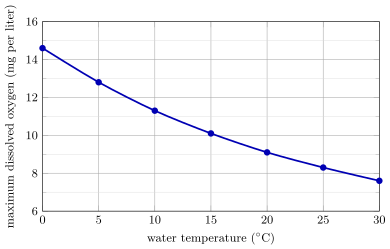
A power plant takes water from a river at C to cool itself and discharges it at C. It is assumed that a cool-water fish of this river needs at least 9 mg of oxygen per liter.
- Read the maximum dissolved oxygen content at C and at C.
- Describe how this content varies when the temperature increases.
- Calculate the quantity of oxygen lost per liter of water between upstream and downstream of the power plant, then express it as a percentage of the upstream value.
- Determine whether the cool-water fish can live immediately downstream of the power plant.
- Name this type of pollution.
- When the temperature of the water increases, fish breathe faster. Explain how this makes the situation worse.
Solution
- The graph gives about mg per liter at C and mg per liter at C.
- The warmer the water, the less oxygen it can dissolve: the maximum content goes from mg per liter at C to mg per liter at C.
- The loss is mg per liter, that is:
- Downstream of the power plant, the water cannot contain more than mg of oxygen per liter. This value is lower than the 9 mg per liter needed: the cool-water fish cannot live there.
- The water has received no substance, only heat: it is thermal pollution.
- A fish that breathes faster consumes more oxygen. Yet the warmed water contains less of it. Needs increase at the very moment the resource decreases: the risk of suffocation is doubly increased.
Similar exercises
- The green lake and the well solved
- Recognizing the types of pollution solved
- Recognizing four indicator invertebrates solved
- A pond over the months solved
- Fertilizer dose and leached nitrates solved
The course of the chapter · All the exercises of the chapter