Life Sciences (Grade 10, Lebanon) · Chapter 7 · Tutorial exercise
Twenty-four hours in a green pond
Pollution of fresh water · B. Eutrophication and groundwater · level 2
Statement
In summer, the water of a pond very rich in nitrates and phosphates is green: it is loaded with microscopic algae. A probe records the dissolved oxygen at a depth of one meter for twenty-four hours. The Sun rises around 6:00 and sets around 18:00.
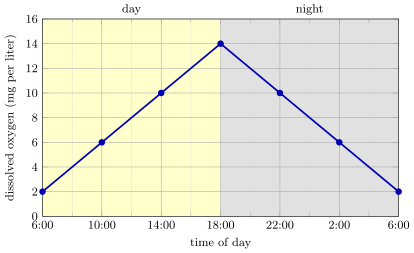
- Identify the highest and the lowest dissolved oxygen content, as well as the time of each.
- Describe the variation of the dissolved oxygen during the day.
- Calculate the variation of the dissolved oxygen per hour during the day.
- Explain this variation.
- Explain the variation observed during the night.
- State at what moment the fish of this pond are most at risk of dying of suffocation.
- A person measures the oxygen of this pond at 16:00 and concludes that the water is of excellent quality. Criticize this conclusion.
Solution
- The highest content is per liter, at 18:00. The lowest is per liter, at 6:00.
- During the day, from 6:00 to 18:00, the dissolved oxygen increases steadily: it goes from 2 to per liter.
- The content increases by per liter in 12 hours:
- Algae are chlorophyll-bearing plants. In the light, they carry out photosynthesis, which is accompanied by a release of oxygen. As they are very numerous, they release much more of it than the living beings of the pond consume: oxygen accumulates in the water.
- At night, photosynthesis stops, for lack of light. But respiration continues: the algae themselves, the animals and the bacteria that decompose the dead algae consume oxygen. The content therefore decreases, from 14 to per liter.
- The fish are most at risk of dying at the end of the night, around 6:00: the dissolved oxygen is then at its lowest, at per liter, a value insufficient for most fish.
- At 16:00, the dissolved oxygen is high (about per liter), but this is only one moment of the day. This value results from the photosynthesis of algae in excess, and it collapses every night. A single measurement, made in broad daylight, hides the lack of oxygen at the end of the night: this water is in reality eutrophic.
What the exercise establishes: linking the oxygen of eutrophic water to photosynthesis and respiration, and being wary of an isolated measurement.
Similar exercises
- The BOD of three waters solved
- A river downstream of a dairy solved
- A biotic index at three sites solved
- A sand column to imitate the soil solved
- The green lake and the well solved
The course of the chapter · All the exercises of the chapter