Life Sciences (Grade 10, Lebanon) · Chapter 8 · Tutorial exercise
A borehole that is too greedy
Management and protection of fresh water · A. Aquifers · level 2
Statement
An irrigation borehole is brought into service in an unconfined aquifer. The drawdown of the aquifer is measured at different distances from the borehole, for two pumping rates.
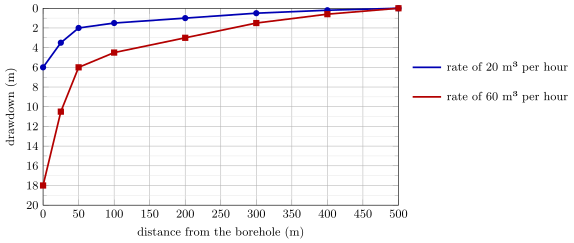
Two old wells are located nearby. Before the borehole was brought into service, well P1, 50 m from the borehole, contained 4 m of water; well P2, at 200 m, contained 2 m of water.
- Define the drawdown of an aquifer.
- Read the drawdown in the borehole itself for each of the two rates.
- Describe how the drawdown varies with distance from the borehole.
- Compare the drawdowns obtained for the two rates, at the same distance.
- Read the drawdown at wells P1 and P2 for the rate of 20 m³ per hour, then determine whether these wells still contain water.
- Answer the same question for the rate of 60 m³ per hour.
- Suggest two solutions so that the borehole no longer deprives the neighboring wells of water.
Solution
- Drawdown is the fall in the level of an aquifer caused by pumping.
- In the borehole (distance 0), the drawdown is for the rate of 20 m³ per hour and for the rate of 60 m³ per hour.
- The drawdown is greatest in the borehole, then it decreases with distance from it, very quickly at first, then more slowly. At 500 m, it is zero. The water table forms a funnel around the borehole: the cone of depression.
- At each distance, the drawdown is three times greater for the rate of 60 m³ per hour than for that of 20 m³ per hour: compared with in the borehole, compared with at 50 m. By tripling the rate, the drawdown has been tripled.
- For the rate of 20 m³ per hour, the drawdown is at well P1 (50 m) and at well P2 (200 m). Well P1 contained 4 m of water: remain. Well P2 contained 2 m of water: remains. Both wells still contain water.
- For the rate of 60 m³ per hour, the drawdown is at well P1 and at well P2. These values exceed the height of water the wells contained (4 m and 2 m): the water table has fallen below the bottom of both wells, which are dry.
- The rate of the borehole can be reduced, for example to 20 m³ per hour, by using more economical irrigation such as drip irrigation. Boreholes can also be located far from existing wells, at a distance where their cone of depression no longer reaches them: this is one of the purposes of the authorization required before drilling.
What the exercise establishes: reading a cone of depression and predicting its effect on neighboring wells.
Similar exercises
- The water budget of a basin solved
- An aquifer over two years solved
- A coastal aquifer turning salty solved
- Covering the soil in winter solved
- Two wastewater treatment plants solved
The course of the chapter · All the exercises of the chapter