Life Sciences (Grade 10, Lebanon) · Chapter 8 · Tutorial exercise
A coastal aquifer turning salty
Management and protection of fresh water · A. Aquifers · level 2
Statement
The cross section represents an unconfined aquifer at the seaside, before much water is pumped from it. In the rock, the dashed line separates two different waters, X and Y.
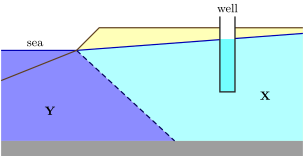
Over the years, boreholes multiply in the plain. In the well of the cross section, the level of the water table relative to sea level and the chloride content of the water, chlorides being abundant in seawater, are recorded.
| Year | 0 | 10 | 20 | 30 |
|---|---|---|---|---|
| Volume pumped in the plain (million m³ per year) | 2 | 5 | 9 | 12 |
| Level of the aquifer relative to the sea (m) | ||||
| Chlorides in the well water (mg per liter) | 40 | 50 | 300 | 2 000 |
- Identify waters X and Y.
- Explain why water Y lies beneath water X.
- Describe how the level of the aquifer changes over the thirty years and explain it.
- Describe how the chloride content of the well water changes.
- Relate these two changes.
- Name the phenomenon observed.
- List two consequences of this phenomenon for the inhabitants of the plain.
Solution
- Water X, under the land, is the fresh water of the aquifer. Water Y, continuous with the sea, is salt water.
- Salt water is denser than fresh water: for the same volume, it is heavier. It therefore lies beneath the fresh water, which “floats” on it.
- The level of the aquifer falls steadily: it was 4 m above sea level in year 0, it is at sea level in year 20 and 2 m below in year 30. Over the same period, the volume pumped has gone from 2 to 12 million m³ per year: more water is withdrawn than the aquifer receives, it is overexploited.
- The chloride content remains low for ten years (40 then 50 mg per liter), then it increases very sharply: 300 mg per liter in year 20, 2 000 mg per liter in year 30. The well water has become salty.
- As long as the water table is clearly higher than the sea, the fresh water flows toward the sea and pushes back the salt water: the well gives fresh water. When the level of the aquifer falls to sea level, then below it, the fresh water no longer pushes back the salt water, which advances into the rock under the land and reaches the well.
- This is salt water intrusion into a coastal aquifer.
- The well water is no longer drinkable, and it can no longer be used for irrigation, because salt damages crops and soils. The inhabitants must look for water further from the sea or bring it in from elsewhere, at great expense.
What the exercise establishes: linking the overexploitation of a coastal aquifer, the fall in its level and salt water intrusion.
Similar exercises
- The water budget of a basin solved
- An aquifer over two years solved
- A borehole that is too greedy solved
- Covering the soil in winter solved
- Two wastewater treatment plants solved
The course of the chapter · All the exercises of the chapter