Life Sciences (Grade 10, Lebanon) · Chapter 8 · Tutorial exercise
A plain, an aquifer and the sea
Management and protection of fresh water · B. Protecting water · level 3 (hard)
Statement
A coastal plain lives from market gardening irrigated by furrows. All its water comes from an unconfined aquifer.
Part A. Mean annual budget of the aquifer, in millions of cubic meters.
| Item | Volume |
|---|---|
| Recharge by infiltration of precipitation | 20 |
| Pumping for irrigation | 18 |
| Pumping for the drinking water of the towns | 6 |
| Pumping for industry | 2 |
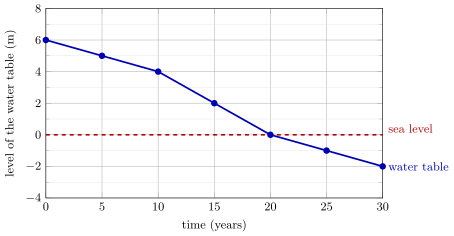
Part B. For thirty years, in a well located 1 km from the shore, the level of the water table relative to sea level has been followed, as well as the quality of the water.
| Year | 0 | 10 | 20 | 30 |
|---|---|---|---|---|
| Chlorides (mg per liter) | 40 | 45 | 120 | 900 |
| Nitrates (mg per liter) | 15 | 30 | 48 | 66 |
Part C. Three measures are being considered: replacing furrow irrigation with drip irrigation, which would reduce irrigation water by 40%; repairing the leaks in the drinking water network, which would reduce the pumping of the towns by 25%; treating the wastewater of the towns and reusing 3 million cubic meters of it per year for irrigation, instead of water from the aquifer.
- Calculate the total pumping and compare it with the recharge.
- Read the level of the aquifer in years 0, 20 and 30, then describe how it changes.
- Explain this change using the budget of part A.
- Describe how the chlorides change and explain it using the graph.
- Describe how the nitrates change and suggest their origin.
- State since about when the well water has no longer been drinkable because of nitrates.
- Calculate the volume of water saved by each of the three measures of part C.
- Calculate the total pumping if the three measures are applied, then draw a conclusion.
- Suggest two farming practices that would lower the nitrate content of the aquifer.
- Write a summary of a few lines explaining why the aquifer of a coastal plain is a fragile resource.
Solution
- The total pumping is: The recharge is only 20 million cubic meters per year: each year, 6 million cubic meters more are withdrawn than the aquifer receives.
- The water table is 6 m above sea level in year 0, at sea level in year 20 and 2 m below in year 30. It has kept falling: 8 m in thirty years.
- Withdrawals exceed recharge: each year, more water leaves the aquifer than enters it. The reserve decreases, and the water table goes down: the aquifer is overexploited.
- The chlorides remain low until year 10 (40 then 45 mg per liter), increase in year 20 (120 mg per liter) and reach 900 mg per liter in year 30. The graph shows that the water table reaches sea level in year 20, then drops below it. The fresh water no longer pushes back the seawater, which penetrates the rock and reaches the well: this is salt water intrusion.
- The nitrates increase steadily: from 15 to 66 mg per liter in thirty years. They come from the fertilizers supplied to the market garden crops: the share that the plants do not absorb is leached by rainwater and by excess irrigation water, which seep down to the aquifer.
- The drinkability limit is 50 mg of nitrates per liter. The content was 48 mg per liter in year 20 and 66 in year 30: the limit was crossed shortly after year 20, that is, about ten years ago.
- Drip irrigation saves 40% of 18 million, that is, million cubic meters. Repairing the leaks saves 25% of 6 million, that is, million cubic meters. Reusing treated wastewater replaces 3 million cubic meters of water from the aquifer.
- Together, the three measures save: The total pumping becomes: It is lower than the recharge (20 million): the aquifer once again receives more water than it loses. Its level can rise again and, over time, the fresh water can push back the salt water.
- Reasoned fertilization can be practiced: calculating the dose of fertilizer from the needs of the crop and applying it in several stages. The soil can also be covered between two crops by a cover crop, which traps the remaining nitrates. Drip irrigation also helps, because it avoids the excess water that carries the nitrates away.
- The aquifer of a coastal plain is renewed only by the infiltration of part of the precipitation: if more than this recharge is pumped from it, its level falls. Being close to the sea, it is then invaded by salt water. Lying under fields, it also receives the nitrates that the crops do not use and that the soil does not retain. In both cases, the degradation is slow to appear and even slower to repair: withdrawals must therefore be adjusted to the recharge and fertilizer inputs limited before the water is lost.
What the exercise establishes: drawing up the budget of an aquifer, linking overexploitation, salt water intrusion and nitrates, and quantifying the effect of management measures.
Similar exercises
- An aquifer over two years solved
- A borehole that is too greedy solved
- A coastal aquifer turning salty solved
- Covering the soil in winter solved
- Two wastewater treatment plants solved
The course of the chapter · All the exercises of the chapter