Life Sciences (Grade 10, Lebanon) · Chapter 8 · Tutorial exercise
An aquifer over two years
Management and protection of fresh water · A. Aquifers · level 2
Statement
For two years, from September to August, the depth of the water table of an unconfined aquifer is followed in a monitoring well. The first year is rainy (950 mm of precipitation), the second is dry (500 mm). In this region, it rains from October to April.
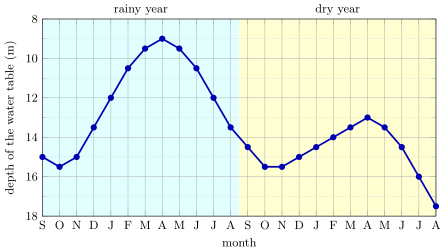
- Read the depth of the water table in October and in April of the rainy year.
- Calculate by how many meters the water table rose during the rainy season of the rainy year.
- Explain this rise.
- Explain the fall observed from May to October.
- Calculate the rise of the water table during the rainy season of the dry year and compare it with that of the rainy year.
- Compare the depth of the water table at the beginning and at the end of the two years.
- A nearby well is 16.5 m deep. State when it dries up, then predict what would happen if a third year were as dry as the second.
Solution
- During the rainy year, the water table is at a depth of in October and in April.
- The water table rose by:
- From October to April, it rains. Part of the precipitation seeps into the ground, moves down through the permeable rock and reaches the aquifer: this is recharge. The rock fills with water over a greater height, and the water table rises.
- From May to October, it hardly rains any more: the aquifer is no longer recharged. But it continues to flow toward the springs and rivers, and water is pumped from it, especially in summer for irrigation. It loses water without receiving any: its surface goes down.
- During the dry year, the water table goes from in October to in April: it rises by only , compared with in the rainy year. With almost half as much precipitation, infiltration, and therefore recharge, was much lower.
- At the start of the monitoring, the water table is at a depth of . At the end of the second year, it is at : in two years, it has fallen by . The low recharge of the dry year has not made up for what the aquifer lost.
- The well dries up when the water table falls below its bottom, at : this happens in August of the dry year, when the water table is at . If a third year were just as dry, the aquifer would start from a lower level, rise little in winter and fall even lower in summer: the well would be dry earlier and for longer.
What the exercise establishes: reading the recharge of an aquifer on a graph and relating it to the precipitation of the year.
Similar exercises
- The water budget of a basin solved
- A borehole that is too greedy solved
- A coastal aquifer turning salty solved
- Covering the soil in winter solved
- Two wastewater treatment plants solved
The course of the chapter · All the exercises of the chapter